Bible, psalms, sermon

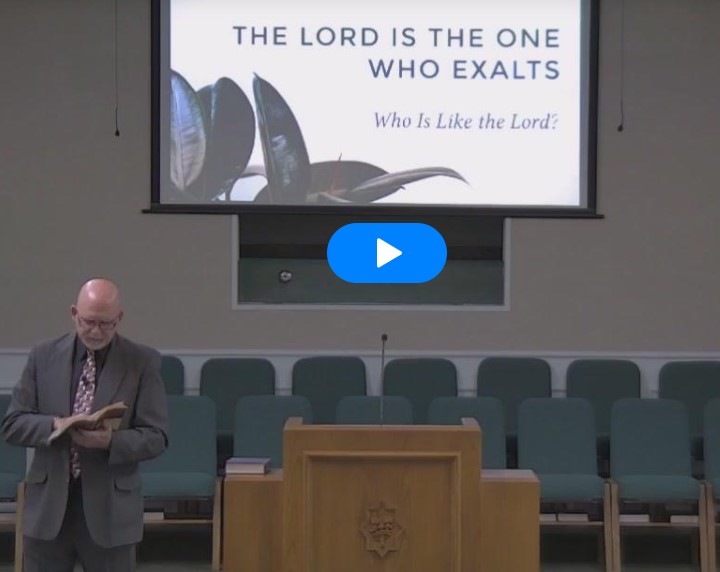
Who Is Like the Lord?

Psalm 113 is the first psalm in the Great Hallel of Passover (Pss 113-118). One thing that we find in the text is that we should exalt the LORD at all times. Because of the liberation of God’s people through the Passover, verse 1 describes the radical change that has occurred for the Hebrews. While in Egypt, they moaned and cried out because of oppression. Now, however, they shout “Hallelu Ya” (Praise the Lord)! Before the Passover, they were the servants of Pharaoh, but afterwards servants of the LORD. Three times in the text, there is an emphasis that the “name of the LORD” (YHWH) should be praised. To the Hebrews, the name was symbolic of someone’s character, so the praise the name was to shine a light on the character of the LORD. He is YHWH, the “I Am Who I Am” who fulfills his promises. At the burning bush, Moses is told that God is the I Am, the God of Abraham, Isaac, and Jacob, who will free the people and deliver them into the land promised to those ancestors. Because of who he is, we are to praise him now (whatever our current circumstances) and praise him forevermore. From the dawn to dusk, his name is to be praised (vv. 2-3).

Another thing we find in the text is that the LORD is the Exalted One. He is over all the nations. There is no God like him. His glory is described as being not “in” the heavens but “above” them. Who is like him? He sits on high as King of the Universe (vv. 4-5). Yet this great and mighty God who dwells above the heavens humbles himself. We are told that he stoops down to look upon the heavens and the earth. What is it he searches for as he lowers himself (rather non-regally) to stoop and search the earth?

The text tells us that he does this because the LORD is the One who exalts. The surprising thing in verses 7-9 is that the object of his gaze are the poor and the childless. We are told he raises the poor from the dust and the needy from the dung hill (NIV, “ash heap”). He even puts the poor onto level ground with royalty. The psalm reminds us of the parable of Jesus about the rich man and Lazarus. The poor beggar Lazarus is exalted at the end of the story while the rich man is punished. In the ministry of Jesus, we find his care focused on the blind, the lame, the lepers, the tax collectors, the so-called “sinners” (as defined by the religious elites). He shows compassion to them but engages in debate and argument with the rich and powerful (both politically and religiously). The placement of the poor and the prince on level ground can also be seen in the selection by the Spirit of Jesus of two of the primary early Christian leaders–Paul, the well-educated Pharisaic rabbi, and Peter, the plain-spoken fisherman. Jesus places them on equal footing (or even places Peter a little above as he was selected for leadership much earlier than Paul).

The other object of God’s focus, as mentioned above, is the childless woman. She will be “settled” in her home “as” a happy mother. The text doesn’t promise she will be a mother, but God will bless her just as he blesses the woman with child. Still, the statement reminds us of the care the LORD has for the motherless wife–Sarah, Rachel, Samson’s mother, and Hannah most notably. In fact, some scholars have noted the similarities between words and phrases of this psalm and Hannah’s song in 1 Samuel 2. Both images (the poor being exalted and seated and the childless being settled and happy) are apt images for the Exodus. The slaves are liberated from poverty; the mothers who lost children find happiness.

This compassion for the lowly and exaltation of the humble is the story of Jesus. Paul tells us that Jesus, though he was in very nature God, did not grasp at equality with God but humbled himself to become a servant. (The God who stoops in Psalm 113 is the same humble God seen in Jesus.) Jesus lowers himself into the dirt and dung of human existence, even to the point of a violent and humiliating death on a Roman cross. But then God the Father exalted him! He gave him “the name” (mentioned three times in Psalm 113) that is “above” every name (as God is “above” the heavens) so that all tongues will confess “Jesus is LORD” (Hallelu Ya!), for the name above all names is the name YHWH, the LORD.

This is also the story of the Church. Paul tells us that God chose the foolish and the lowly in order to shame the wise and the powerful. His purpose in so doing was to make sure that no one could boast about themselves (that is, be arrogant). They could only praise him in humility. Praise the LORD!

Subscribe to receive email notifications of new posts.

Who Is Like the Lord?” Psalm 113
Watch the sermon or download the audio.
psalms, sermon

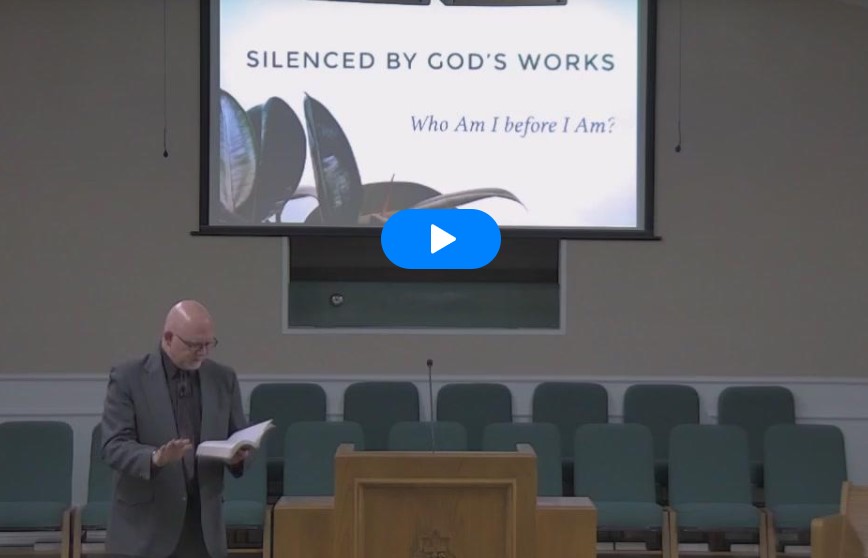
Who Am I Before I Am?

In Psalm 8, the psalmist asks, “What is man?” But not, “what is man” as an abstract concept. Rather, he asks “what is man” in relationship to YHWH (LORD), the “I Am” before whom we each stand. In the text, we see first that the psalmist is awed by God’s name. YHWH our Lord he says at the beginning, how majestic or wonderful is your name in all of the earth! YHWH, the “I Am Who I Am,” is the covenant name of God for his people Israel. He doesn’t marvel that God is in all. No, it is God’s name that is in all the earth. Everywhere the psalmist looks, he sees the character of God, his name. It is like the character of Woody in the movie Toy Story. The most significant thing to him is that he bears the name of Andy, as does each of the toys in Andy’s room.

A second thing in the text is that the psalmist is silenced by God’s works. He sees the glory of God set above the heavens, the way I recently was out with my family on a dark, clear night and we stood in awe gazing up at a sky full of stars. Carl Sagan, though an atheist, felt the same silence as he encountered the vastness of God’s handiwork.

Who are we? We find that we live on an insignificant planet of a humdrum star lost in a galaxy tucked away in some forgotten corner of a universe in which there are far more galaxies than people.

Carl Sagan, Cosmos, episode 7

Like Sagan, the psalmist asks, “What is humanity?” But the psalmist doesn’t ask about humanity as an abstract concept. He says, “What is humanity, that you should be mindful of us?” You who created the cosmos, who set the moon, sun, and stars in place. Why should you pay attention to us? How often, after all, do we look at and think about ants? He parallels the question with another, who is the “Son of Man” (ben adam) that God should care for him? The term we translate “care” is the term used of God coming and intervening in the lives of humanity–Sarah’s barrenness and the sorrow and suffering of the Hebrews in Egypt are but two examples.

Verse 2 tells us God silences the foe–he shabats (from which we get Sabbath) or causes to cease their fighting and wrath. It is the image of the Creator from Genesis 1, who ordered the dark chaotic waters into a beautiful heavens and earth in which he could shabat on the seventh day. But though the chaotic enemies are silenced, the psalmist says that praise rises from babes and infants, like “little us” looking up at the vast starry night. In Matthew 21, Jesus is healing in the temple and the children are rejoicing at his works and shouting, “Hosanna to the Son of David!” When the priests and scribes indignantly oppose this scene, Jesus quotes to them psalm 8:2a. The children saw the “wonderful things” Jesus was doing (the same Greek word, thaumasia, that appears in the Septuagint for the “majestic” things of the name of YHWH in Psalm 2), they cried out in praise. After Jesus’ reply, the priests and scribes are silenced, just as in Psalm 8:2c, the enemies of YHWH are silenced.

Finally, the psalmist tells us that humans are honored with God’s image. In the ancient near east, mythology said humans were created to serve the minor gods. The king was a “Son of God” and the priests were the representatives of God, but everyone else was a servant. Not in Psalm 8, however. Probably reflecting on the theology of Genesis 1, he says humans are a little lower than the angels. They are not servants. Instead, they are “crowned with glory and honor” (v 5) and “made rulers” (v 6). For the psalmist, there was not just one king who was the Son of God. All were Sons. All were Daughters. All were kings and queens. And he doesn’t restrict this understanding to Israel alone. It is all of humanity that he describes. It is like C.S. Lewis’s The Chronicles of Narnia, where the children become kings and queens of the land.

Where God silenced the chaotic forces of the cosmos, humans are called to conquer the wilderness of creation, to build a civilization. God has “put everything under their feet.” The imagination of the psalmist is speaking of the ideal understanding of humanity, not the current, fallen reality we see day by day. Now, we live with both the ideal and the reality. As C.S. Lewis put it,

“You come of the Lord Adam and the Lady Eve,” said Aslan. “And that is both honor enough to erect the head of the poorest beggar, and bow the shoulders of the greatest emperor on earth. Be content.”

C.S. Lewis, Prince Caspian

James May notes that the problem is that we have turned reality around, so that we are focused on ourselves instead of focused on God (as the psalmist is). We make it anthropocentric rather than theocentric.

Dominion has become domination; rule has become ruin; subordination in the divine purpose has become subjection to human sinfulness. The creatures suffer. . . . [We should] share the wonder and exuberance of the psalm at the majesty of God but know fear and trembling at the disparity between the vision of humanity and the reality of human culture.

James May, Psalms

The first thing we should bring under our feet is ourselves. Too often, we try to overthrow others. The writer of Hebrews helps us see how Psalm 8 was intended–Christocentric. In Hebrews 2:5-9, he notes that the world to come was not given to subjugation of angels but to humans. The writer notes that we do not yet see everything under the feet of humans, but we do see Christ, who was made a little lower than the angels for a while now crowned with glory and honor (cf. Ps 8:5) because he suffered death. If humanity as God intended it is to be as Christ is, then Philippians 2:5-11 tells us we should humble ourselves as Christ did and trust that, in his time, God will exalt us as he did our savior and king.

YHWH, our Lord, how majestic is your name in all the earth.

Jesus, our King, how exalted is your name in all the heavens.

Who am I before I Am?

I am in Christ, and I am called to bear the name of YHWH and his Christ.

Subscribe to receive email notifications of new posts

Psalm 8 “Who Am I Before I Am?”