Bible, sermon, Stories That Shape Our Life

Crossing the Jordan

(Taken from a sermon at the end of an interim pastorate a few weeks before the new pastor would arrive on the field.) These are some of the memes the week after the winter 2021 storms that wreaked havoc on Texas:

  • 2021? Feels more like 2020 and a half
  • 2020: the year from hell / 2021: the year hell froze over
  • 2020: learn to stay home / 2021: same, but now let’s test your survival skills
  • Shame on all of you who made fun of Bernie Sanders. Now look at you sitting on your couch in the same outfit!

Like many of you, my wife and I conserved electricity and wore extra layers of clothes to help keep the power grid up in our area. I think Lucy stayed in the living room by the fire most of the week! Friends and family went without power or had water damage from frozen pipes or leaking roofs. And many had to conserve or boil water as a by-product.

It may have felt like a winter wilderness, but it only lasted for a week. The Israelites wandered in the wilderness for forty years. Their daily lives were a marginal existence for an entire generation. Finally, however, it was time for them to cross over into the land promised by God to their ancestors, to Abraham, Isaac, and Jacob. That is the focus of the biblical passage in Deuteronomy 31:1-8. The story of the Israelites crossing the Jordan is one of the stories that shapes our lives.

Subscribe to receive email notification of new posts.

It Is Time to Leave the Wilderness

The interim period between pastors is like a wilderness experience. It is a time when you have left the familiarity of the old pastorate and you walk by faith with the interim minister in anticipation of the new minister who will soon come to the field. Many times at the beginning or in the middle of the interim, you are not sure what lies in the future. Frequently, it is a marginal existence, like the wilderness, with the interim minister only on the field on weekends or certain ministries suspended for a season. Even churches not in an interim situation felt this margin living In 2020, as the pandemic forced worship online or delayed or canceled a number of “normal” ministry opportunities.

But as an interim ends (or for us in 2021, as we may be nearing a turning point with the pandemic in the U.S.), a new day dawns. Like Moses, the interim minister cannot follow the congregation into the new pastorate but he can provide some words of wisdom. With the end of the interim, the journey ends for the minister but it is just the start for the congregation. It is for this reason that Moses says repeatedly in this passage, “Be strong and courageous” and “do not fear.

As rough as the wilderness was, some had become comfortable in it. For some, it was all they had ever known. Often, Christians are comfortable with the way church has been done (sometimes for decades). Some might become familiar with the leadership or worship style of the interim pastor or liked the reduced meeting times of the interim period or pandemic restrictions. In the wilderness, there were times the people wanted to return to Egypt. So as they crossed into the new land promised by God, some would continue to look backward toward the wilderness or beyond.

Moses tells the people not to be terrified because of “them.” Whether with the start of a new pastorate or the end of a pandemic, there are new problems coming and new issues to address. Perhaps new ministries need to be started. Other ministries need to be revived or restarted. This can be just as scary as conquering a land. Don’t be terrified by the unknown or the new, for God will be with you.

God Crosses the Jordan Ahead of You

The blessed news is that we are not alone. We do not have to go it alone. God is with us. He says in the passage that he will never leave us nor forsake us. This is a blessed hope and comfort. What is more, God crosses before us and enters the new land, the new phase of ministry, the new situation we cannot fully understand, ahead of us. He will fight the battles for us, if we will only trust in him. We are called to be obedient, but he himself is our strength and our shield.

Whether in the interim period or through the pandemic, we have seen God at work even in the wilderness. He helps those who trust in him to grow closer to one another as they grow closer to him. He uses the wilderness time to resolve and heal various issues lingering since we have left Egypt as he prepares us to enter the new land of Canaan. He has helped us learn to adapt to new situations and to seek his guidance when times seem dark. As we have trusted him through the wilderness, we find over and again that he proves himself faithful. God knows the future to which he is calling us. We can trust him and rest in him.

Follow Your Leader Into the Promised Land

Before Moses died in the wilderness, God called Joshua to be the new leader. This leader would go with them into the promised land. Like God, Moses says Joshua will go ahead of the people into the new land and will lead the people. Yet he was just as scared and unaware of the future as the Israelites. Moses gives Joshua the same words of comfort to be strong and courageous and not to be afraid. For churches beginning a new pastorate, the new pastor enters into the unknown with the congregation. He will lead and the congregation will follow, but he and the congregation both truly follow God who promises to go before them. On the other side of the Jordan is the promised land. It is a land of new opportunities and new ministries. It is the place of hope and new life.

For all the hope that lies beyond, however, the promised land is scary. Change is scary! For the Israelites, they were moving from the barren wilderness to beautiful farmland. They knew how to be nomads. That was comfortable. What did they know about farming? What did they know about living in settled villages and permanent homes? So church life now or even in the past may not be what it will be in the future. We always need to be ready for change, but especially in times of transition.

An interesting feature of the wilderness story is Joshua himself. He was one of the twelve spies originally sent into the land for forty days just a few months after the people left Mount Sinai. Ten spies returned saying there was no way they could enter the land. Joshua and Caleb said, there is a way–with God! The Israelites listened to the ten, however, and so they were condemned to wander in the wilderness for forty years because they refused to face change. They refused to trust God for fear of the unknown. Yet during those forty years in the wilderness, as the current generation gave way to a new generation, the legend of Joshua–the man who trusted God–grew. Joshua trusted God so we can trust him to guide us.

During the interim period, the congregation has prayed for a new leader and prepared themselves for the next phase of life together. They have trusted God that he would guide them to the right person to take them into the next years of ministry. When that man is called, you must trust God and trust him.

Notice one key difference in Moses’ encouragement to Joshua than to the Israelites. Moses adds to his admonition to Joshua, “do not be discouraged.” For forty years, Moses bore the brunt of complaints about the wilderness and the struggles and needs ever wore down on him. Moses understood that ministry could have periods of discouragement. The new pastor will make mistakes. Joshua made mistakes. The role of the congregation is to encourage the minister, pray for him, trust him to lead, and forgive the mistakes that are made. Certainly, this doesn’t mean to forgive moral lapses or ignore ungodly actions, but we are called to trust in the leader as he trusts in God. He will lead the congregation into the promised land.

Soon after this, God let Moses ascend to Mount Nebo. Moses was able to look over and see the promised land even though he wasn’t able to enter in with the people. And then Moses died. In some ways, the role of the interim minister is similar. He has the opportunity to see the potential within the congregation as he helps the congregation believe in that possibility as well. So be strong and courageous. Do not be afraid. Trust God who is going on before you. Trust your new leader and give him grace to fail. Help him conquer giants as you enter into the land of promise.
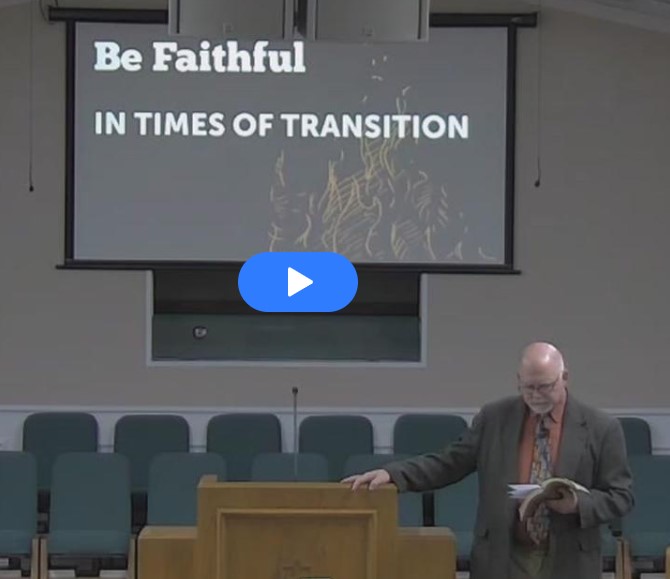
Crossing the Jordan (Deut 31:1-8)

Chronicles, sermon

In Times of Transition

As David neared the end of his life, he knew he would not be the person to build the temple. He could have been like King Hezekiah, who, when told that a later generation would be conquered by the Babylonians, simply replied, “Well, at least there will be peace during my reign!” (2 Kings 20:19). So David could have thought, “Well, I will leave all those issues to Solomon.” Instead, we read in 1 Chronicles 22:5, “David said, ‘My son Solomon is young and inexperienced, and the house to be built for the Lord should be of great magnificence and fame and splendor in the sight of all the nations. Therefore I will make preparations for it.’ So David made extensive preparations before his death.”

David was like any father of an 8 year old boy who needed to build a pinewood derby race car. When the son shows up at the races, he has a sleek, well-lubricated, and properly weighted car because dad “showed” the son how to do it. Or the 12 year old girl whose entry into the science fair looks like a graduate research project (but she struggles to explain the project or the data without dad’s help). The Chronicler in chapter 22 tells us of David’s private instructions about Solomon. The focus of our devotional today, however, will be on David’s public presentation of Solomon to the Israelites as the next king (ch. 28). The two chapters contain much of the same information, though there are slight differences. David in chapter 28 is preparing the people for their new king. He is also preparing Solomon to build the temple for YHWH. A church in transition between pastorates can learn several lessons about how to prepare themselves for the coming of the new pastor.

First, we see that in times of transition, we should be faithful. David chose to be faithful even though he had been told “no.” In verses 2-3, he says the reason God told him he couldn’t build the temple was that he was a man of war and bloodshed. David goes on to recount his history as king (vv. 2-7) and gives a charge to the gathered Israelites (v. 8) and to Solomon(vv. 9-10). The Chronicler presents David as Moses in the book of Deuteronomy, giving speeches on God’s faithfulness during the Exodus and wilderness wanderings. Moses, though he was told he would not enter into the “good land” (v. 8 cf. Deut. 1:25, 35; 3:25; 4:21-22; 6:18; 8:7, 10; 9:6; 11:17), prepared the Israelites through his speeches and leadership in the book of Deuteronomy. So David had prepared for the building of the temple and was not explaining the future through a speech. Solomon is also presented as Joshua in this passage, for David and Moses both commission them before all Israel (v. 20 cf. Deut 31:7). Yet when David emphasizes the need to be faithful and obey the commands in order to remain in the good land, the Chronicler’s true audience to hear this injunction are his fellow returning exiles, who understood what it was to live in exile.

David was essentially saying, I am passing away. Do not place your hope in me. Hope instead in God. For it was God who chose the house of David (v. 4); God who chose Solomon to build the temple (vv. 5-7); God who gave the commandments that would lead to life and peace (v. 8); God who would remain when David was gone (v. 20). And it is God who is still at work today! Not that in verse 7, God says, “I will . . . if . . .” God is always faithful. Are we? But it is not just the leader who is to be faithful. All must be faithful. Verse 8, if it were written in Texan, would say, “I charge y’all . . .” (not “you” singular) “in the sight of all Israel.” The people were to keep the commands so they could possess the good land and give it as an inheritance to their descendants. This again is imagery from Deuteronomy.

While verse 8 was to all Israel, verses 9-10 are directed to Solomon, but they still apply to all. Solomon is to serve God with a whole heart and a willing mind, for God knows the intent and motives of each person. This should give us hope, for he knows if we meant well even if we fail in our acts. It should also be a warning, however, that God knows if our motives are selfish, even if we succeed and/or seem to take action for others. Therefore, we are to seek him, for he will be found by us. But, David warns, if we forsake God, he will reject us. This seeking and forsaking is not a reference to a single act or moment in time. David is speaking about lifelong trajectories, but each act can be a step in one direction or the other.

A second thing David notes is that we should be prepared. David was prepared. He gave Solomon detailed plans. Plans for the temple. Plans for the courts. Plans for the priests and the Levites. And David had already set aside funds for the project. In verse 19, David says he has written all of this because the Lord’s hand had been upon him. David is presented as Moses on Mt. Sinai in the Exodus story (Exod 25-30; esp. Exod 25:9). God gave Moses the plans for the tabernacle. So now God has given David the plans for the temple. Many members of the congregation have invested in the church for years. All of their work has been a preparation for the years to come. The Transition Team has led the congregation to prepare itself for the immediate future. The Pastor Search Committee is now at work preparing for the next pastorate. Some of us might not see the completion of the current work, but we must be faithful in the preparation, as David (who made all the plans but didn’t see the completion of the project).

The third thing David says is to be confident. In verses 5-6 and in verse 10, David tells Solomon that he is God’s choice for the one to build the temple. In verse 10, David tells Solomon to “be strong and do the work.” Later, in verse 20, David says to “be strong and courageous and do the work.” Solomon, like Joshua, is to be the next leader of the people. Both led the people into a new era (Joshua into the land; Solomon into a time of peace and temple-building). So David tells Solomon, like Moses told Joshua, to be strong and courageous (Deut 31:7). Again like Moses to Joshua, David told Solomon to not be afraid or to be discouraged (verse 20; cf. Deut 31:8). But Solomon is not simply like Joshua in this text. He is also like Bezalel, the builder of the tabernacle in Exodus. Moses gave the plans to Bezalel to build the tabernacle (Exod 38:22). So David has given Solomon the plans for the temple. Both Bezalel and Solomon are told to “do the work” (verses 10 and 20; cf. Exod 36:1-2).

Why does David tell Solomon to be strong and courageous, and especially who should he not be afraid or discourages? Because the LORD God would be with him. Not just any god, but YHWH, the God of the covenant promises would be with Solomon (v. 20). Not only is he the God of the covenant promises to Abraham, Isaac, and Jacob. Not only is he the God who made a covenant with Israel through Moses at Sinai. He is “my God” (i.e., David’s God). David says, the God who made a covenant with me that you, Solomon, will build the temple and reign after my death–it is that covenant God who will be with you. If he promised you would build the temple, what have you to fear? And so it is the same covenant God who is with us. And we have the sure promise from him of a new covenant through his Son, Jesus Christ.

Note that the Joshua language of verse 20 (be strong and courageous; do not fear or be discouraged) is modified with the promise “he will not fail you or forsake you until all the work for the service of the temple of the LORD is finished.” To us, that sounds like God will only be with Solomon for a while. But if we look more closely, we find that this is Bezalel language. Just as Bezalel led the workers to complete the tabernacle (Exod 36:1; 39:32), so Solomon’s priests, Levites, and skilled professionals (v. 21) will help him to accomplish the work of building the temple.

In many ways, David and Solomon (Moses and Bezalel, and Moses and Joshua) are like runners in a relay race. A relay team will only be successful if the runners are faithful to do their part in the leg of the race that they run; if the runners are prepared to give and to receive the exchange; and if they are confident that each member will do his or her part in running the race. The intent of the Chronicler is the same for us today as for his audience in his day. In the days ahead, we are called to be faithful, to be prepared, and to be confident, for God is not finished with us yet.

Subscribe to receive email notification of new posts.

“In Times of Transition” 1 Chronicles 28

Bible, sermon

Rebuilding the Temple

Ezra 3:10-13.  As certain social distancing restrictions begin to lift, how to we faithfully relaunch physical worship services and ministry? By comparing the returning exiles’ rebuilding of the temple with our relaunching the church, we can see that we should seek God’s help to understand the times and know what to do; that we may occasionally make mistakes; that we may need to take incremental steps; and that our future may not be exactly the same as our past. Through it all, however, the glory of the future will outshine the glory of the past.

An example of semantron mentioned in the sermon: