Bible, Christian living, current-events

Whose Land Is It, Anyway?

I recently saw a meme floating around social media: “Israel doesn’t occupy the land.  They OWN it. Gen 15:18-21.” There were multiple amens attached.  Certainly, the intent was to show support for Israel in response to the horrific attack on civilians by Hamas last October.  While there is a promise made in Genesis 15, it is curious that a verse referencing “everlasting” was not used, such as Genesis 13:15.  “All the land that you see I will give to you and your offspring forever.”  This promise to Abraham was restated to him (Gen 17:8), then confirmed to Isaac (Gen 26:3) and Jacob (Gen 35:12). 

The main problem with the meme, however, is that it assumes God’s promise was without condition.  That’s certainly the response of many to the meme: “God does not break his covenants;” “Truth!” “Of course!” “I stand with Israel.”  Yet the Bible itself does not support the idea that God gifted the land to Abraham’s descendants in perpetuity without condition.

Subscribe to receive email notification of new posts.

Before we consider these conditions, however, we must first address the wording of the meme.  God’s promises to the Patriarchs does not mean Israel “owns” the land.  God explicitly rejects such a concept in Leviticus 25:23.  “The land is mine and you reside in my land as foreigners and strangers.”  God is the only owner of the land.

God set conditions that the people must not sin but obey his commands in order to remain in the land (Deut 4:1; 5:33; 11:8-9; Josh 23:16; 2Chr 7:19-22; 33:7-9; Jer 11:5; 32:21-23).  Abraham, though a foreigner at the time, was told by God that the land was an everlasting possession for him and his descendants, and they must keep God’s covenant (Gen 17:8-9).  As Abraham was a foreigner in the land he possessed, so his later descendants were also foreigners.  Before entering the land, God warned Israel that if they did not keep his commands, the land would vomit them out as it did the Canaanites (Lev 18:25-28; 20:22).  By the monarchy’s end, God tells them, “You came and defiled my land and made my inheritance detestable” (Jer 2:7).  These detestable acts included idolatry (Deut 4:25-27; 11:16-17; 30:17-18, Josh 23:16; 1Ki 14:15-16; Jer 16:13-15) and unethical treatment of their fellow human beings.

If Israel wanted to remain in the land, they were to follow the way of justice, treating people fairly and without partiality (Deut 16:18-20).  They were not to mistreat the foreigner living among them, but were to treat them as native-born.  “Love them as yourself, for you were foreigners in Egypt,” God commands (Lev 19:33-34).  Israel was driven from the land because of violence and bloodshed (Ezek 7:23-25), because they did not care for the orphan and the poor (Jer 5:28). 

Many American Christians think they are called to unwavering support of Israel, regardless of the civilian casualty count.  Some even believe Israel is entitled to the whole land, to expel the Palestinians.  This, however, contradicts the statements above (love the foreigner, care for the orphan and poor).  I believe it also misreads the biblical story, as the New Testament authors continuously spiritualized the return to the land and the restoration of Israel, reading these as the gathering of Jews and Gentiles in Christ.  For instance, the writer to the Hebrews says we don’t look toward the earthly Jerusalem (Heb 12:22; 13:11-14), but join with the Hebrew faithful, who lived as foreigners and strangers on the earth . . . longing for a better country to come (Heb 11:13-16).  Remember, he’s writing to Hebraic Jews, saying the land and temple are no longer important.

Now God can give the land to whomever he wants, whether Israeli or Palestinian.  That is up to God.  But as Christians, we should not turn a blind eye to the suffering of Palestinians—both Christian and Muslim—who did not take part in nor condone October 7.  We should not encourage Israel to violate the command of God, to limit retribution to no more than an eye for an eye (Exod 21:23-25).  1,200 died in Israel that day; why is it okay for 35,000 civilians to die in Gaza? (Even if these deaths have been overreported by 90%, that is still 3 “eyes” to 1!)

Even if the restoration texts apply to the modern state of Israel, they are not living by these texts.  The return described by the prophets were of a people with the law written on their hearts (Jer 31:31-34) of flesh, filled with God’s Spirit to obey the commands (Ezek 11:14-21; 36:22-32), and wholeheartedly fearing the Lord (Jer 32:36-41).  Isaiah says, strangers would be united to those returning (Isa 14:1-2).  Ezekiel adds that they would treat the foreigner residing in the land as a native-born and give them an inheritance in the land in whatever tribe they resided (Ezek 47:21-23).  God the shepherd would gathers his lost sheep, caring for the weak and injured but destroying the sleek and strong (Ezek 34:15-16).  It would seem Israel should strive to find a way to leave in peace with their Palestinian neighbors, not take their land nor prosper at their expense, lest they themselves be destroyed. 

The modern secular state of Israel does not live the righteous life described within the Hebrew Bible.  In many ways, their response is far more like the people of Ezekiel’s own day than his vision of the future people of God.  Just after Jerusalem’s fall to Babylon, the attacked people say to themselves: “Abraham was only one man, yet he possessed the land.  But we are many; surely the land has been given to us as our possession” (Ezek 33:24).  Yet God tells them they violated his commands, worshiped idols, shed the blood of the innocent, defiled their neighbor’s wives, and relied on their own sword rather than on him.  “Should you then possess the land?” (Ezek 33:25-26) asks the God who was, and is, and is to come (Rev 1:8).

Subscribe to receive email notification of new posts.
Chronicles, sermon

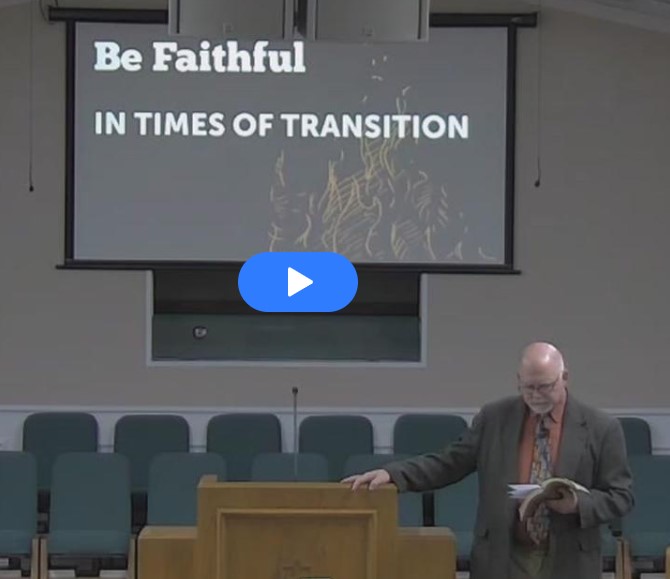
In Times of Transition

As David neared the end of his life, he knew he would not be the person to build the temple. He could have been like King Hezekiah, who, when told that a later generation would be conquered by the Babylonians, simply replied, “Well, at least there will be peace during my reign!” (2 Kings 20:19). So David could have thought, “Well, I will leave all those issues to Solomon.” Instead, we read in 1 Chronicles 22:5, “David said, ‘My son Solomon is young and inexperienced, and the house to be built for the Lord should be of great magnificence and fame and splendor in the sight of all the nations. Therefore I will make preparations for it.’ So David made extensive preparations before his death.”

David was like any father of an 8 year old boy who needed to build a pinewood derby race car. When the son shows up at the races, he has a sleek, well-lubricated, and properly weighted car because dad “showed” the son how to do it. Or the 12 year old girl whose entry into the science fair looks like a graduate research project (but she struggles to explain the project or the data without dad’s help). The Chronicler in chapter 22 tells us of David’s private instructions about Solomon. The focus of our devotional today, however, will be on David’s public presentation of Solomon to the Israelites as the next king (ch. 28). The two chapters contain much of the same information, though there are slight differences. David in chapter 28 is preparing the people for their new king. He is also preparing Solomon to build the temple for YHWH. A church in transition between pastorates can learn several lessons about how to prepare themselves for the coming of the new pastor.

First, we see that in times of transition, we should be faithful. David chose to be faithful even though he had been told “no.” In verses 2-3, he says the reason God told him he couldn’t build the temple was that he was a man of war and bloodshed. David goes on to recount his history as king (vv. 2-7) and gives a charge to the gathered Israelites (v. 8) and to Solomon(vv. 9-10). The Chronicler presents David as Moses in the book of Deuteronomy, giving speeches on God’s faithfulness during the Exodus and wilderness wanderings. Moses, though he was told he would not enter into the “good land” (v. 8 cf. Deut. 1:25, 35; 3:25; 4:21-22; 6:18; 8:7, 10; 9:6; 11:17), prepared the Israelites through his speeches and leadership in the book of Deuteronomy. So David had prepared for the building of the temple and was not explaining the future through a speech. Solomon is also presented as Joshua in this passage, for David and Moses both commission them before all Israel (v. 20 cf. Deut 31:7). Yet when David emphasizes the need to be faithful and obey the commands in order to remain in the good land, the Chronicler’s true audience to hear this injunction are his fellow returning exiles, who understood what it was to live in exile.

David was essentially saying, I am passing away. Do not place your hope in me. Hope instead in God. For it was God who chose the house of David (v. 4); God who chose Solomon to build the temple (vv. 5-7); God who gave the commandments that would lead to life and peace (v. 8); God who would remain when David was gone (v. 20). And it is God who is still at work today! Not that in verse 7, God says, “I will . . . if . . .” God is always faithful. Are we? But it is not just the leader who is to be faithful. All must be faithful. Verse 8, if it were written in Texan, would say, “I charge y’all . . .” (not “you” singular) “in the sight of all Israel.” The people were to keep the commands so they could possess the good land and give it as an inheritance to their descendants. This again is imagery from Deuteronomy.

While verse 8 was to all Israel, verses 9-10 are directed to Solomon, but they still apply to all. Solomon is to serve God with a whole heart and a willing mind, for God knows the intent and motives of each person. This should give us hope, for he knows if we meant well even if we fail in our acts. It should also be a warning, however, that God knows if our motives are selfish, even if we succeed and/or seem to take action for others. Therefore, we are to seek him, for he will be found by us. But, David warns, if we forsake God, he will reject us. This seeking and forsaking is not a reference to a single act or moment in time. David is speaking about lifelong trajectories, but each act can be a step in one direction or the other.

A second thing David notes is that we should be prepared. David was prepared. He gave Solomon detailed plans. Plans for the temple. Plans for the courts. Plans for the priests and the Levites. And David had already set aside funds for the project. In verse 19, David says he has written all of this because the Lord’s hand had been upon him. David is presented as Moses on Mt. Sinai in the Exodus story (Exod 25-30; esp. Exod 25:9). God gave Moses the plans for the tabernacle. So now God has given David the plans for the temple. Many members of the congregation have invested in the church for years. All of their work has been a preparation for the years to come. The Transition Team has led the congregation to prepare itself for the immediate future. The Pastor Search Committee is now at work preparing for the next pastorate. Some of us might not see the completion of the current work, but we must be faithful in the preparation, as David (who made all the plans but didn’t see the completion of the project).

The third thing David says is to be confident. In verses 5-6 and in verse 10, David tells Solomon that he is God’s choice for the one to build the temple. In verse 10, David tells Solomon to “be strong and do the work.” Later, in verse 20, David says to “be strong and courageous and do the work.” Solomon, like Joshua, is to be the next leader of the people. Both led the people into a new era (Joshua into the land; Solomon into a time of peace and temple-building). So David tells Solomon, like Moses told Joshua, to be strong and courageous (Deut 31:7). Again like Moses to Joshua, David told Solomon to not be afraid or to be discouraged (verse 20; cf. Deut 31:8). But Solomon is not simply like Joshua in this text. He is also like Bezalel, the builder of the tabernacle in Exodus. Moses gave the plans to Bezalel to build the tabernacle (Exod 38:22). So David has given Solomon the plans for the temple. Both Bezalel and Solomon are told to “do the work” (verses 10 and 20; cf. Exod 36:1-2).

Why does David tell Solomon to be strong and courageous, and especially who should he not be afraid or discourages? Because the LORD God would be with him. Not just any god, but YHWH, the God of the covenant promises would be with Solomon (v. 20). Not only is he the God of the covenant promises to Abraham, Isaac, and Jacob. Not only is he the God who made a covenant with Israel through Moses at Sinai. He is “my God” (i.e., David’s God). David says, the God who made a covenant with me that you, Solomon, will build the temple and reign after my death–it is that covenant God who will be with you. If he promised you would build the temple, what have you to fear? And so it is the same covenant God who is with us. And we have the sure promise from him of a new covenant through his Son, Jesus Christ.

Note that the Joshua language of verse 20 (be strong and courageous; do not fear or be discouraged) is modified with the promise “he will not fail you or forsake you until all the work for the service of the temple of the LORD is finished.” To us, that sounds like God will only be with Solomon for a while. But if we look more closely, we find that this is Bezalel language. Just as Bezalel led the workers to complete the tabernacle (Exod 36:1; 39:32), so Solomon’s priests, Levites, and skilled professionals (v. 21) will help him to accomplish the work of building the temple.

In many ways, David and Solomon (Moses and Bezalel, and Moses and Joshua) are like runners in a relay race. A relay team will only be successful if the runners are faithful to do their part in the leg of the race that they run; if the runners are prepared to give and to receive the exchange; and if they are confident that each member will do his or her part in running the race. The intent of the Chronicler is the same for us today as for his audience in his day. In the days ahead, we are called to be faithful, to be prepared, and to be confident, for God is not finished with us yet.

Subscribe to receive email notification of new posts.

“In Times of Transition” 1 Chronicles 28