psalms, sermon

In the Darkness of Despair

Gloom, despair, and agony on me.
Deep, Dark depression, excessive misery!
If it weren’t for bad luck, I’d have no luck at all!
Gloom, despair, and agony on me.

This farcical song of lament was popular on the television show Hee Haw while I was a kid in the 1970s. It reflects, however, the element of lament that is the most popular form of literature in the book of Psalms. There are times we cry out to God in desperation. Psalm 13 is one such passage.

The psalmist is dejected and confused in his time of despair. “How long?” he asks God four times. When will this end? As humans, we all have external struggles and troubles of life that begin to cause internal doubts as we wrestle with conflicting thoughts and eventually prompt spiritual concern about the presence of God and his lack of response to our prayers. The psalmist focuses on all three issues (external, internal, spiritual), but he inverts them and begins first and foremost with a prayerful address to God. His prayer is about his dread of God’s absence, his anxiety created by conflicting thoughts and emotions, and his fear of his enemy’s triumph. In our minds we can package these into nice little groupings of “external,” “internal,” and “spiritual,” but in reality, we are human. These fears and concerns are all intertwined and build upon and incite one another.

Second, the psalmist desperately cries out to God. It would be easy to claim God has abandoned us. If he is all loving, why does he allow my suffering? If he is just, why does he allow my enemy to overpower me? But we live in a broken and fallen world, not the fantasy of a thirty minute sitcom. Some struggles and problems are not quickly resolved. But the psalmist prays in the midst of his darkness. “How long?” he asks. “Look at me!” he demands. “Respond to me!” he pleads. He will not give up on God. He will not deny God but confesses his dependence of the Lord. Whether he overcomes his enemy or is destroyed, God has been and will remain, “my God!”

Finally, the psalmist is determined to be committed. There is a shift in the psalm to an emphasis on trusting God in the midst of the storm. He will trust in God’s steadfast love–the love evidenced time and again through the history of the Israelite people. He will rejoice in God’s salvation even when he doesn’t presently see it. He will sing of the bounty God has blessed him with even when it isn’t in all the fullness he would wish.

Because of God’s faithfulness in the past, the psalmist refuses to accept a present apart from God or imagine the future apart from God’s salvation. Martin Luther said of Psalm 13 that it is “the state in which hope despairs, and yet despair hopes at the same time; and all that lives is ‘the groaning that cannot be uttered’ wherewith the Holy Spirit makes intercession for us, brooding over the waters shrouded in darkness.” Or, as the man in desperation cried out to Jesus, “I do believe; help me overcome my unbelief!” (Mk 9:24, NIV). In the midst of desperation, we have hope because Christ. On the cross he felt abandoned by God yet he entrusted his spirit to his Father; he felt betrayed by the humans he had come to save but asked his Father to forgive them. And he trusted his Father would raise him back to life even when all hope seemed lost. So our hope in in Christ. “For we who are alive are always being given over to death for Jesus’ sake, so that his life may also be revealed in our mortal body” (2 Cor 4:11, NIV).

19th Century preacher Charles Spurgeon and a friend, walking through the English countryside, came across a barn and stood looking at the weather vane on top. It read “God is Love.” Spurgeon said he did not think it was appropriate to put such a statement on a weather vane, for the vane is quite changeable but God’s love is unchanging. His friend, however, told him he misunderstood the meaning of the farmer. The weather vane stated a truth: no matter which way the wind might blow, God . . . IS . . . love! It doesn’t matter if a cool breeze indicates a good season or happy time, or hot winds bring desolation or a dry period, or a ferocious gale points toward a chaotic and stormy period in your life. God is love, and Christ is our guide pointing the way through.

Subscribe to receive email notifications of new posts

Sermon link
Psalm 13 “In the Darkness of Despair”
psalms, sermon

Who Am I Before I Am?

In Psalm 8, the psalmist asks, “What is man?” But not, “what is man” as an abstract concept. Rather, he asks “what is man” in relationship to YHWH (LORD), the “I Am” before whom we each stand. In the text, we see first that the psalmist is awed by God’s name. YHWH our Lord he says at the beginning, how majestic or wonderful is your name in all of the earth! YHWH, the “I Am Who I Am,” is the covenant name of God for his people Israel. He doesn’t marvel that God is in all. No, it is God’s name that is in all the earth. Everywhere the psalmist looks, he sees the character of God, his name. It is like the character of Woody in the movie Toy Story. The most significant thing to him is that he bears the name of Andy, as does each of the toys in Andy’s room.

A second thing in the text is that the psalmist is silenced by God’s works. He sees the glory of God set above the heavens, the way I recently was out with my family on a dark, clear night and we stood in awe gazing up at a sky full of stars. Carl Sagan, though an atheist, felt the same silence as he encountered the vastness of God’s handiwork.

Who are we? We find that we live on an insignificant planet of a humdrum star lost in a galaxy tucked away in some forgotten corner of a universe in which there are far more galaxies than people.

Carl Sagan, Cosmos, episode 7

Like Sagan, the psalmist asks, “What is humanity?” But the psalmist doesn’t ask about humanity as an abstract concept. He says, “What is humanity, that you should be mindful of us?” You who created the cosmos, who set the moon, sun, and stars in place. Why should you pay attention to us? How often, after all, do we look at and think about ants? He parallels the question with another, who is the “Son of Man” (ben adam) that God should care for him? The term we translate “care” is the term used of God coming and intervening in the lives of humanity–Sarah’s barrenness and the sorrow and suffering of the Hebrews in Egypt are but two examples.

Verse 2 tells us God silences the foe–he shabats (from which we get Sabbath) or causes to cease their fighting and wrath. It is the image of the Creator from Genesis 1, who ordered the dark chaotic waters into a beautiful heavens and earth in which he could shabat on the seventh day. But though the chaotic enemies are silenced, the psalmist says that praise rises from babes and infants, like “little us” looking up at the vast starry night. In Matthew 21, Jesus is healing in the temple and the children are rejoicing at his works and shouting, “Hosanna to the Son of David!” When the priests and scribes indignantly oppose this scene, Jesus quotes to them psalm 8:2a. The children saw the “wonderful things” Jesus was doing (the same Greek word, thaumasia, that appears in the Septuagint for the “majestic” things of the name of YHWH in Psalm 2), they cried out in praise. After Jesus’ reply, the priests and scribes are silenced, just as in Psalm 8:2c, the enemies of YHWH are silenced.

Finally, the psalmist tells us that humans are honored with God’s image. In the ancient near east, mythology said humans were created to serve the minor gods. The king was a “Son of God” and the priests were the representatives of God, but everyone else was a servant. Not in Psalm 8, however. Probably reflecting on the theology of Genesis 1, he says humans are a little lower than the angels. They are not servants. Instead, they are “crowned with glory and honor” (v 5) and “made rulers” (v 6). For the psalmist, there was not just one king who was the Son of God. All were Sons. All were Daughters. All were kings and queens. And he doesn’t restrict this understanding to Israel alone. It is all of humanity that he describes. It is like C.S. Lewis’s The Chronicles of Narnia, where the children become kings and queens of the land.

Where God silenced the chaotic forces of the cosmos, humans are called to conquer the wilderness of creation, to build a civilization. God has “put everything under their feet.” The imagination of the psalmist is speaking of the ideal understanding of humanity, not the current, fallen reality we see day by day. Now, we live with both the ideal and the reality. As C.S. Lewis put it,

“You come of the Lord Adam and the Lady Eve,” said Aslan. “And that is both honor enough to erect the head of the poorest beggar, and bow the shoulders of the greatest emperor on earth. Be content.”

C.S. Lewis, Prince Caspian

James May notes that the problem is that we have turned reality around, so that we are focused on ourselves instead of focused on God (as the psalmist is). We make it anthropocentric rather than theocentric.

Dominion has become domination; rule has become ruin; subordination in the divine purpose has become subjection to human sinfulness. The creatures suffer. . . . [We should] share the wonder and exuberance of the psalm at the majesty of God but know fear and trembling at the disparity between the vision of humanity and the reality of human culture.

James May, Psalms

The first thing we should bring under our feet is ourselves. Too often, we try to overthrow others. The writer of Hebrews helps us see how Psalm 8 was intended–Christocentric. In Hebrews 2:5-9, he notes that the world to come was not given to subjugation of angels but to humans. The writer notes that we do not yet see everything under the feet of humans, but we do see Christ, who was made a little lower than the angels for a while now crowned with glory and honor (cf. Ps 8:5) because he suffered death. If humanity as God intended it is to be as Christ is, then Philippians 2:5-11 tells us we should humble ourselves as Christ did and trust that, in his time, God will exalt us as he did our savior and king.

YHWH, our Lord, how majestic is your name in all the earth.

Jesus, our King, how exalted is your name in all the heavens.

Who am I before I Am?

I am in Christ, and I am called to bear the name of YHWH and his Christ.

Subscribe to receive email notifications of new posts
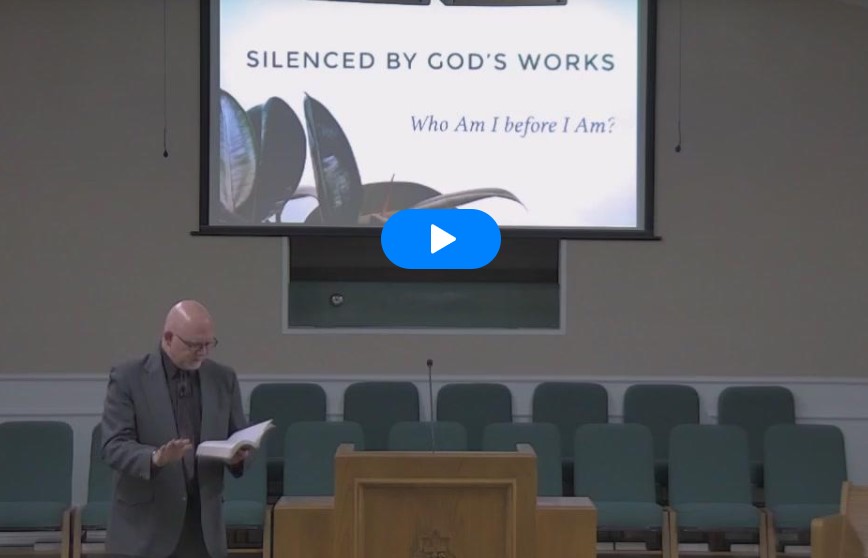
Psalm 8 “Who Am I Before I Am?”

Bible, Jesus, sermon

The Way of Adam/ The Way of Christ

1 Cor 8:1-13. Meat offered to idols doesn’t seem to be a topic relevant to modern Westerners. Yet the body of Christ in a post-COVID world faces the same issues confronted by the first century Corinthian church. Their “strong” said they could eat meat, even in temples, because they knew there is only one God and the idols are nothing. They didn’t want their rights impeded by the “weak,” who believed in gods or demons behind the idols and so wouldn’t eat the meat.

While Paul philosophically agreed with the strong, he rejected their way of Adam, trusting in “knowledge” motivated by self-interest; a way that leads to death and destruction. Paul called the Corinthians to follow the way of Christ, putting the needs of others ahead of your own for the sake of love; a way that leads to community and life. While we can question governmental policies aimed at flattening the curve of COVID, we should never let our “rights” destroy the fellowship of the church or our witness of Christ’s love and rule. Paul would say, if going out in public without a mask causes death to the vulnerable and destruction to Christian unity and witness, I will never go without a mask again.

Subscribe to receive email notifications of new posts

The Way of Adam/The Way of Christ

Article referenced in sermon: Church Don’t Let Coronavirus Divide You

sermon

Beyond Thanksgiving to Thanks-living

“Beyond Thanksgiving to Thanks-living” Colossians 3:12-17 (click this link to open)

While we remember God’s blessings with a special day of thanks, shouldn’t we reflect on what makes God thankful and strive to live that way everyday?  God’s desire for us to live as an authentic witness as a transformed person within a unified body.

What is Thanks-living?  Letting the peace of Christ (the New Man) rule our hearts as we confess our flaws to each other.  Putting to death what remains of the Old Man (Adam) as we bear with and forgive the Old Man we see in other believers.  Thanking God for the unity of believers as we embrace the diversity of our fellowship.

Beyond Thanksgiving to Thanksliving sermon

SermonAudio.com — archive First Baptist Church, Coahoma, TX, November 24, 2019