psalms, sermon

The Way of Wisdom

Psalm 1 contrasts the way of the wise with the way of the wicked. We can hear the psalmist ask three questions of us. First, if you stop, what do you hear? Many of us today are so media and technology-driven that we honestly don’t stop. We cannot stand awkward silence. A slight pause in the conversation and our smartphone immediately pops out. The psalmist warns that those who begin by walking with the wicked soon find themselves stand among sinners. Ultimately, they sit down in mocking and scornful judgment of others (which sounds a lot like Facebook!). So the wicked “stop,” but they do not listen. In contrast, the wise intentionally cause themselves to stop and listen. We are told that they delight to meditate on the instruction of the Lord day and night.

Second, when trouble comes, how do you stand? The wise are described as the very Tree of Life deeply rooted beside the rivers of Eden. Drought will not damage them nor storms uproot them. In all seasons, the wise flourish. They bless the lives of others with fruit of their good works and comfort to the afflicted with their shade of their leaves. The wicked, however, are like chaff easily blown about by the slightest breeze. They are useless to themselves or to others when the trials of life come. (Sadly, Jeremiah 17:5-8 describes a “middle way”between these two–those who have a shallow faith–as a bush struggling in the desert for its own sustenance, unable to bless others.)

Third, in your journey, who do you trust? The psalmist describes life as a journey. With assurance he tells us the LORD watches over the way of the righteous. Like a GPS, God can guide the steps of the righteous even when our path is obscured by the storms of adversity, the fog of loss and struggle, or the darkness of fear and doubt. Not so the wicked, concludes the psalmist. He tells us that they vanish on their path and so will not stand in the judgment.

In Aesop’s Fables, Prometheus tells Zeus he created two roads. The path of freedom starts out difficult and rocky but ultimately becomes a wide easy plain with beautiful gardens and rivers. The path of slavery starts out easy and wide, a joy to behold, but eventually it becomes an impassible, treacherous climb. Thanks be to God who sent Jesus our Christ to show us the way–no, to be the Way, the Truth, and the Life. As his one body, he called his followers to help our brothers and sisters through those difficult parts of our journey. Together, we delight in our Christ, we meditate on the One who embodies the Law.

Subscribe to receive email notifications of new posts

“The Way of Wisdom” — Psalm 1

sermon

Finding Peace in a Troubled World

The year 2020 has been turbulent, to say the least. No matter where you live, there is something happening. The chaotic confusion brought on by the sudden emergence of a global pandemic. Fear of learning you or a loved one is COVID-19 positive. Concerns over the economic instability created by lock-downs and partial business closures. The vanishing toilet paper! Political arguments about whether or not to wear a mask. In the midst of this, unfortunate acts of racial injustice have resulted in both peaceful protests and, unfortunately, riots and other violent acts.

Americans may think I am only talking about their country. But the turmoil over COVID itself and the proper response to it are ongoing worldwide. George Floyd’s death has ignited questions about justice in Israel over the treatment of Ethiopian Jews and Palestinians and in Australia over Aboriginal deaths in police custody. As always, there is also political unrest. China is cracking down on Hong Kong, provoking border skirmishes with India, and threatening Christian churches they cannot reopen unless they teach loyalty to the Party. Then there’s the locusts . . . in Kenya . . . in Pakistan. (In case you forgot about the ecological troubles.)

And so the question arises, how can we find peace in such a troubled world? Where can it be found. Isaiah also wrestled with this quest for peace in chapter 57 verses 15-21. He describes life apart from God as a tossing sea full of mire and mud. But he tells us there is a God of peace sitting above this troubled world, just as Genesis 1 tells us the Spirit of God hovered over the chaotic waters. Genesis 1 “ends” on day 7, but God has never stopped his work of bringing order and stability out of chaos and turmoil. Though he could destroy us in an instant, he patiently bears with us in our sin and injustice, prompting us forward. Calling us to repentance.

God offers peace to those far away and to those near to him. He offers healing and comfort, if we but accept it. So how do we find this peace he offers? Isaiah tells us that God not only lives in a high and lofty place far above the turmoil, but–amazingly–God also chooses to live in the midst of the turmoil, with those who are contrite and lowly in spirit. To know God, you must humble yourself and give your fears and insecurities over to God. To know peace, you must first be contrite and seek forgiveness for your sins and prejudicial thoughts. Then, you can find peace in the midst of chaos, like Betty and Curtis Tarpley. Married for 53 years, they both contracted COVID and died on June 18 within an hour of each other. Yet despite the illness, they died hand in hand, the image of peace, grace, and love in the midst of troubled times.

Subscribe to receive email notifications of new posts

Sermon: Where Can Peace Be Found? Isaiah 57:15-21

Bible, Jesus, sermon

What Moon Are You?

In the Sermon on the Mount, Jesus says, “You are the light of the world. A town built on a hill cannot be hidden.  Neither do people light a lamp and put it under a bowl. Instead they put it on its stand, and it gives light to everyone in the house. In the same way, let your light shine before others, that they may see your good deeds and glorify your Father in heaven” (Matt 5:14-16). In John’s Gospel, Jesus proclaims himself to be the Light of the World (John 8:12; 9:5).

What’s going on? How are both Jesus and his followers the light of the world? Jesus is the true light; his followers are called to reflect his light. Jesus is the sun; Christians are the moon. The moon doesn’t generate its own light. It only reflects the light that is generated by the sun. So if you call yourself a Christian, the question becomes–what kind of moon are you?

Full Moon

Jesus said the light should be placed on a lamp stand so that it can give light to everyone in the house. Everything we have is from the true light. The blessings and gifts we receive from him should flow out in service to others. We should strive, therefore, to be a full moon in order to bring light to as many people in a dark world as we possibly can.

Jesus warned that you shouldn’t put the light under a bowl. We can do this in one of two ways.

New Moon

First, we can separate from the world, like the Essenes in Jesus day. If we do, we might be “holy” but we will never be the change agent Jesus intended. Notice how the Essenes aren’t mentioned even once in the New Testament! Turning away from the world is like being a new moon. You may fully reflect the sun, but it is meaningless in your church walls or prayer closets. New moons do not shine their light toward a world that needs it.

Lunar Eclipse

Second, we can hide the light is to strive to be just like the world. We conform completely to our culture for a number of reasons. We might be engaged in the sins around us. We might think conformity is the best way to share the light. Or we may not even realize how much our culture’s values have replaced those of the Kingdom. When the moon moves into the earth’s shadow, it results in a lunar eclipse. The moon no longer reflects the sun because it’s allowed the world to separate it from the source of its light.

Jesus tells his followers to live such good lives that it leads others to glory our Father in heaven.

We are to live lives of virtue. We are to have beautiful deeds that draw people to the Father and the true source of light, his Son. If we never share the true source of our deeds, however, we can become a solar eclipse. We can allow our lives to come between the sun and the world so that they see something beautiful . . . but also something deadly. Staring at a solar eclipse can cause blindness. Not bearing witness to Jesus as the source of your good deeds can create spiritual blindness.

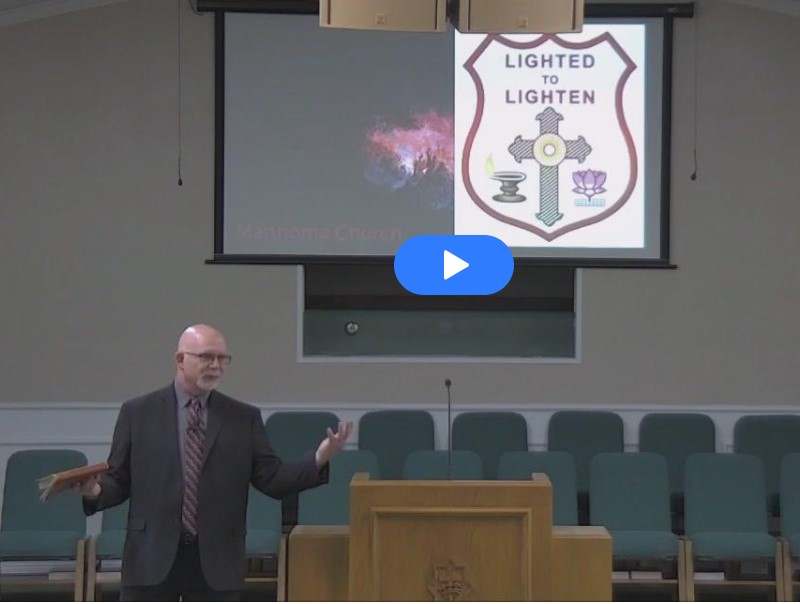
The Mar Thoma are Indian Christians who say their church originated with the Apostle Thomas. I have always liked their motto on their logo. It emphasizes the purpose for our calling to bless others because we have been blessed. The Gospel is not just about personal salvation. It has social and cosmic dynamics. The reason we are “lighted” is so that we can “lighten” others. This should be the purpose statement of all Christians. We need to be a full moon to a dark world until that world turns to the full day of the Son of God.

Subscribe to receive email notifications of new posts

Be a Full Moon to a Dark World (Matt 5:14-16)

Start sermon video
Bible, sermon

Godly Worship, Godly Fasting

Why do humans who say they love God repeatedly misunderstand what it means to worship God and to live a life that honors him? Before the exile, Amos warned about misdirected worship. After the exile, Zechariah noted the same problems remained. Even today, we still find so many who bear the name of Christ acting in the same way. Since these two sermons have a similar theme, I am sharing them together.

Amos (5:18-24) warned about the disruptive nature of the coming Day of the Lord. Today, we are living through one of those disruptive times with the COVID pandemic and racial protests. If we worshiped God the way he wants us too, we would be the salt and light that Jesus called us to be within the midst of this disruptive time. But unfortunately, we often do not understand what true worship means. God, through Amos, told the Israelites their worship didn’t pass three important “tests”: the smell test (God wouldn’t smell their sacrifices), the vision test (God couldn’t see their offerings), and the hearing test (God hated their music). Instead, as Martin Luther King Jr. so often emphasized, the worship God desires is for justice to roll on incessantly like the never-ending lapping of waves on the seashore and for righteousness to flow out from us like an unending river.

A little over 200 years later, as the second temple neared completion, some Israelites came to Zechariah inquiring whether they should continue the fast of remembrance for the destruction of Solomon’s temple. God, through Zechariah (7:4-10), asked if the fast was ever about him at all, or if it was about the loss of their own privileged position within the culture, the destruction of their political capital and collective power, and the embarrassment they felt at “pagans” getting the better of “God’s people.” Zechariah emphasized that true Godly fasting isn’t about simply denying personal desires or denying yourself to honor God. Fasting should be a denial of yourself for the sake of giving yourself for the other, whether that other is your neighbor or your enemy. Zechariah called the people to a fast from deeds of injustice, from acts of selfishness, from structures of oppression, and from plots of evil.

So both Amos and Zechariah emphasized true worship of God is found in active care and compassion for our fellow human beings. To love God we must love humans. The Good News of Jesus as the Christ is not an individualistic call to personal salvation, some type of a “get into heaven free” card for the end of life unrelated to daily living. Christian witness is not about proving the “rightness” of your beliefs through demeaning, confrontational or plain hateful social media posts. Advancing the Kingdom of God doesn’t depend on power politics that aggressively advance your agenda and demonize your opponents. If Jesus is the Christ, he is seated at the right hand of God ruling over all of creation. His followers are called to live and die as he did. Kingdom citizenship requires daily denial of ourselves in order that we might live for others. We are called to struggle against the injustices we encounter–not real or perceived offenses against ourselves or our personal rights (see Paul’s life!)–but injustice against others. We are called to defend the widow, the orphan, the foreigner, the poor–in a word, to seek justice for our neighbor, especially our marginalized neighbor. We don’t worship in anticipation of the future. We worship through living in the present, so God’s will might be done on earth as it already is in heaven.

Subscribe to receive email notifications of new posts

The Worship God Despises; the Worship God Desires (Amos 5:18-24)

The Worship God Despises; the Worship God Desires (link to sermon)

A Call to Godly Fasting (Zech 7:8-10)

A Call to Godly Fasting (link to sermon)
Advent, Jesus, sermon

From Egypt with Love

Hosea 11:1-11. An advent sermon that never made it onto the blog last Christmas. When Herod heard the Magi were seeking the newborn Messiah, his response was to kill the infant boys in the region of Bethlehem–just as Pharaoh killed the Hebrew boys in Israel’s past. Matthew tells us Jesus survived this slaughter because Joseph took the family to Egypt–just as Moses survived the slaughter of his day when “Egypt” took him in (through Pharaoh’s daughter). As the family returned, Matthew quoted Hosea 11:1 as a fulfilled prophecy of this event–even though it wasn’t a messianic text for Hosea. Rather, Hosea sought to remind the Israelites of their past. They were the firstborn son of God that Moses led out of slavery. Hosea then points out to them that their rebellion would soon result in a return to Egypt–to captivity at the hands of the Assyrians. Yet Hosea also held out hope for the future, that the people would return to the land.

Not only did Matthew quote Hosea 11:1 about Jesus’ return from Egypt, but he also quoted Jeremiah 31:15 (Rachel weeping for her children) to describe the slaughter of the innocents. (Again, not a messianic passage.) In Matthew’s view, however, these are not mere proof-texts sought in vain from the scriptures to prove Jesus was the messiah. Rather, they are a call for us to return to those texts and see them in terms of the hope each had. Hosea hoped for the eventual restoration of (the now “lost” ten tribes of) Israel. Jeremiah believed the everlasting love of God for the Hebrews (v. 3) would discipline the unruly calf (v. 18) who was yet his dear son (v. 20). Jeremiah also hoped for a time when a new covenant would be written on the hearts of God’s people (vv. 31-34).

Jesus entered our Egypt–coming into our Egyptian slavery, our wilderness exile–to call us out of Egypt and to bring us home to our Father. This emphasis on Jesus as the New Moses (innocents slaughtered; being called out of Egypt) ties into the genealogy Matthew presents at the start of his gospel. Matthew breaks the great history into 3 units of time separated by 4 persons/events: Abraham, David, Exile (the only non-person), and Messiah. Hinting at Moses almost immediately after this genealogy is a nod that he knows he left out a key individual from his list. The Exile, however, stands in some ways as a cypher for Moses. The people had never completely left exile. They still needed a liberator to free them from bondage. Thus, in reverse order, the Messiah was the beloved Son who would liberate his people and establish a new covenant (from the Exile to the Christ–Jesus, the True Moses). The beloved Son would build the temple of God and establish an everlasting Kingdom of God (David to the Exile–Jesus, the True Solomon). And finally, the beloved Son would be the one through whom God would bless all nations (Abraham to David–Jesus, the True Isaac). So the liberation isn’t just for the Jews. It isn’t even only for the lost tribes. The hope of liberation is for men and women of every tribe and language. “See what great love the Father has lavished on us, that we should be called children of God.” (1 John 3:1)

Subscribe to receive email notifications of new posts

“From Egypt with Love” Hosea 11:1-11

From Egypt with Love Sermon link
From Egypt with Love
Bible, Jesus, sermon

The Way of Adam/ The Way of Christ

1 Cor 8:1-13. Meat offered to idols doesn’t seem to be a topic relevant to modern Westerners. Yet the body of Christ in a post-COVID world faces the same issues confronted by the first century Corinthian church. Their “strong” said they could eat meat, even in temples, because they knew there is only one God and the idols are nothing. They didn’t want their rights impeded by the “weak,” who believed in gods or demons behind the idols and so wouldn’t eat the meat.

While Paul philosophically agreed with the strong, he rejected their way of Adam, trusting in “knowledge” motivated by self-interest; a way that leads to death and destruction. Paul called the Corinthians to follow the way of Christ, putting the needs of others ahead of your own for the sake of love; a way that leads to community and life. While we can question governmental policies aimed at flattening the curve of COVID, we should never let our “rights” destroy the fellowship of the church or our witness of Christ’s love and rule. Paul would say, if going out in public without a mask causes death to the vulnerable and destruction to Christian unity and witness, I will never go without a mask again.

Subscribe to receive email notifications of new posts

The Way of Adam/The Way of Christ

Article referenced in sermon: Church Don’t Let Coronavirus Divide You

Jesus, sermon

Love Your Enemy’s Mother

Matthew 15:21-28.  When Jesus is confronted by a Canaanite woman, she saw herself as a loving mother seeking help for her daughter.  The disciples, however, viewed her as a submissive mongrel who didn’t deserve help or mercy.  Jesus, through his seemingly strange response, proclaims her to be a persistent model of faith.  Jesus not only taught us to love our enemies, but he showed his disciples that they should love their enemy’s mother.  Happy Mother’s Day!

Sermon - Love Your Enemys Mother

Love Your Enemy’s Mother – Matthew 15:21-28

Bible, sermon

Rebuilding the Temple

Ezra 3:10-13.  As certain social distancing restrictions begin to lift, how to we faithfully relaunch physical worship services and ministry? By comparing the returning exiles’ rebuilding of the temple with our relaunching the church, we can see that we should seek God’s help to understand the times and know what to do; that we may occasionally make mistakes; that we may need to take incremental steps; and that our future may not be exactly the same as our past. Through it all, however, the glory of the future will outshine the glory of the past.

An example of semantron mentioned in the sermon:

Bible, Jesus, sermon

The Touch of Life

Mark 1:40-42.  Masks, gloves, social distancing. These are necessary precautions today with COVID-19, but at the same time, Christians cannot let these precautions interfere with our calling to be the body of Christ ministering in the world. We are to be the touch of life to our world the way Jesus himself was. The sermon looks at the story of a leper and some other stories about “touch” in the gospels.  Jesus was ready to touch the lives of others, even if it meant he might be misunderstood or become unclean, so that he could be a blessing and change lives.  We cannot ostracize groups or stigmatize individuals because of fear of COVID-19.  No.  We are called to be the hands of Jesus, touching others and giving life.

Bible, sermon

Darkness or Light in the Day of the Lord

Isaiah 2:12-22 — COVID-19 affects us all. We are all on edge and our lives disrupted. The Old Testament would call this the Day of the Lord.  A day when all of us are brought low. A day when all of us should be brought to repentance and prayer. When the Day of the Lord comes, however, it does nothing more dangerous than to reveal our heart through our actions and the choices we make. Ultimately, we can either respond to the day of the Lord as yet another excuse to blame others or we can see it as an opportunity to serve others. We must chose whether to be darkness or light.