Bible, sermon, Stories That Shape Our Life

Crossing the Jordan

(Taken from a sermon at the end of an interim pastorate a few weeks before the new pastor would arrive on the field.) These are some of the memes the week after the winter 2021 storms that wreaked havoc on Texas:

  • 2021? Feels more like 2020 and a half
  • 2020: the year from hell / 2021: the year hell froze over
  • 2020: learn to stay home / 2021: same, but now let’s test your survival skills
  • Shame on all of you who made fun of Bernie Sanders. Now look at you sitting on your couch in the same outfit!

Like many of you, my wife and I conserved electricity and wore extra layers of clothes to help keep the power grid up in our area. I think Lucy stayed in the living room by the fire most of the week! Friends and family went without power or had water damage from frozen pipes or leaking roofs. And many had to conserve or boil water as a by-product.

It may have felt like a winter wilderness, but it only lasted for a week. The Israelites wandered in the wilderness for forty years. Their daily lives were a marginal existence for an entire generation. Finally, however, it was time for them to cross over into the land promised by God to their ancestors, to Abraham, Isaac, and Jacob. That is the focus of the biblical passage in Deuteronomy 31:1-8. The story of the Israelites crossing the Jordan is one of the stories that shapes our lives.

Subscribe to receive email notification of new posts.

It Is Time to Leave the Wilderness

The interim period between pastors is like a wilderness experience. It is a time when you have left the familiarity of the old pastorate and you walk by faith with the interim minister in anticipation of the new minister who will soon come to the field. Many times at the beginning or in the middle of the interim, you are not sure what lies in the future. Frequently, it is a marginal existence, like the wilderness, with the interim minister only on the field on weekends or certain ministries suspended for a season. Even churches not in an interim situation felt this margin living In 2020, as the pandemic forced worship online or delayed or canceled a number of “normal” ministry opportunities.

But as an interim ends (or for us in 2021, as we may be nearing a turning point with the pandemic in the U.S.), a new day dawns. Like Moses, the interim minister cannot follow the congregation into the new pastorate but he can provide some words of wisdom. With the end of the interim, the journey ends for the minister but it is just the start for the congregation. It is for this reason that Moses says repeatedly in this passage, “Be strong and courageous” and “do not fear.

As rough as the wilderness was, some had become comfortable in it. For some, it was all they had ever known. Often, Christians are comfortable with the way church has been done (sometimes for decades). Some might become familiar with the leadership or worship style of the interim pastor or liked the reduced meeting times of the interim period or pandemic restrictions. In the wilderness, there were times the people wanted to return to Egypt. So as they crossed into the new land promised by God, some would continue to look backward toward the wilderness or beyond.

Moses tells the people not to be terrified because of “them.” Whether with the start of a new pastorate or the end of a pandemic, there are new problems coming and new issues to address. Perhaps new ministries need to be started. Other ministries need to be revived or restarted. This can be just as scary as conquering a land. Don’t be terrified by the unknown or the new, for God will be with you.

God Crosses the Jordan Ahead of You

The blessed news is that we are not alone. We do not have to go it alone. God is with us. He says in the passage that he will never leave us nor forsake us. This is a blessed hope and comfort. What is more, God crosses before us and enters the new land, the new phase of ministry, the new situation we cannot fully understand, ahead of us. He will fight the battles for us, if we will only trust in him. We are called to be obedient, but he himself is our strength and our shield.

Whether in the interim period or through the pandemic, we have seen God at work even in the wilderness. He helps those who trust in him to grow closer to one another as they grow closer to him. He uses the wilderness time to resolve and heal various issues lingering since we have left Egypt as he prepares us to enter the new land of Canaan. He has helped us learn to adapt to new situations and to seek his guidance when times seem dark. As we have trusted him through the wilderness, we find over and again that he proves himself faithful. God knows the future to which he is calling us. We can trust him and rest in him.

Follow Your Leader Into the Promised Land

Before Moses died in the wilderness, God called Joshua to be the new leader. This leader would go with them into the promised land. Like God, Moses says Joshua will go ahead of the people into the new land and will lead the people. Yet he was just as scared and unaware of the future as the Israelites. Moses gives Joshua the same words of comfort to be strong and courageous and not to be afraid. For churches beginning a new pastorate, the new pastor enters into the unknown with the congregation. He will lead and the congregation will follow, but he and the congregation both truly follow God who promises to go before them. On the other side of the Jordan is the promised land. It is a land of new opportunities and new ministries. It is the place of hope and new life.

For all the hope that lies beyond, however, the promised land is scary. Change is scary! For the Israelites, they were moving from the barren wilderness to beautiful farmland. They knew how to be nomads. That was comfortable. What did they know about farming? What did they know about living in settled villages and permanent homes? So church life now or even in the past may not be what it will be in the future. We always need to be ready for change, but especially in times of transition.

An interesting feature of the wilderness story is Joshua himself. He was one of the twelve spies originally sent into the land for forty days just a few months after the people left Mount Sinai. Ten spies returned saying there was no way they could enter the land. Joshua and Caleb said, there is a way–with God! The Israelites listened to the ten, however, and so they were condemned to wander in the wilderness for forty years because they refused to face change. They refused to trust God for fear of the unknown. Yet during those forty years in the wilderness, as the current generation gave way to a new generation, the legend of Joshua–the man who trusted God–grew. Joshua trusted God so we can trust him to guide us.

During the interim period, the congregation has prayed for a new leader and prepared themselves for the next phase of life together. They have trusted God that he would guide them to the right person to take them into the next years of ministry. When that man is called, you must trust God and trust him.

Notice one key difference in Moses’ encouragement to Joshua than to the Israelites. Moses adds to his admonition to Joshua, “do not be discouraged.” For forty years, Moses bore the brunt of complaints about the wilderness and the struggles and needs ever wore down on him. Moses understood that ministry could have periods of discouragement. The new pastor will make mistakes. Joshua made mistakes. The role of the congregation is to encourage the minister, pray for him, trust him to lead, and forgive the mistakes that are made. Certainly, this doesn’t mean to forgive moral lapses or ignore ungodly actions, but we are called to trust in the leader as he trusts in God. He will lead the congregation into the promised land.

Soon after this, God let Moses ascend to Mount Nebo. Moses was able to look over and see the promised land even though he wasn’t able to enter in with the people. And then Moses died. In some ways, the role of the interim minister is similar. He has the opportunity to see the potential within the congregation as he helps the congregation believe in that possibility as well. So be strong and courageous. Do not be afraid. Trust God who is going on before you. Trust your new leader and give him grace to fail. Help him conquer giants as you enter into the land of promise.
Crossing the Jordan (Deut 31:1-8)

Bible, psalms

Flourishing like a Palm and a Cedar

As we think about creation care, I want you to consider two biblical trees: the palm and the cedar.  Recent changes in climate are threatening the cedars of Lebanon, a symbol of pride for that nation (just look at their flag!).  The forests on the mountains of Lebanon are starting to die, however, as the climate warms and dries.  The forests are shifting upwards on the mountains, seeking cold winters, yet they can only go so high.  Soon the southern trees won’t have elevation left to pursue.  If trends continue, some estimates indicate the only trees remaining at century’s end will be at the northern edge of the country.

On the other hand, the palm stands at the forefront of the battle against climate change.  UAE scientists are exploring ways to harvest palm “waste”—leaves, stems, and empty branches—and convert these into biofuel and biochar, which would have less impact than fossil fuels on carbon dioxide emissions.

The Psalmist compares the righteous to these two trees in Ps 92:12-15:

The righteous will flourish like a palm tree,
    they will grow like a cedar of Lebanon;
planted in the house of the Lord,
    they will flourish in the courts of our God.
They will still bear fruit in old age,
    they will stay fresh and green,
proclaiming, “The Lord is upright;
    he is my Rock, and there is no wickedness in him.”

Ps 92:12-15, NIV

Both trees were connected to Solomon’s temple, so they were “planted in the house of the Lord.”  Palms were carved onto wood inside and outside the temple as decorations.  Palms were symbolized by the two pillars on each side of the temple entrance.  The cedars of Lebanon were used in construction as beam supports and paneling.

One reason the psalmist focused on these trees is that they are evergreens.  They are consistent through the different seasons of life, not changing depending on circumstance.  Our righteousness should not come and go but should constantly and consistently flow out of our lives.  Both trees thrive in their environment.  The palm grows in the desert, where there is little water and the temperatures are high.  The cedar grows in the mountains, drawing on the mists from the Mediterranean Sea and thriving in the cold climate.  Their two extreme climates are apt reminders that we are called to thrive wherever we find ourselves.  Whether our spiritual life is on fire or stone cold at the moment, we should trust in the Rock of our salvation and honor him in those periods of life.  Whether our life is pleasant and peaceful as the misted cedar or life’s struggles bear down on us like the desert palm, our Father sustains us.

We are called to “bear fruit,” that is, honor God through acts of justice and righteousness.  Throughout our lives, we are called to service (“in old age staying fresh and green”).  Our lives should be a blessing to others.  Like the Lord, the palm is “upright” and straight.  Its height is an aid to the nomad searching for food, water, and respite from the sun in a dry, barren land.  The maturing cedar’s trunk grows ever sturdier, allowing it to spread out its branches in order to provide shade, shelter, protection, and help to those creatures who live in and under its canopy.  Like the Lord, its fragrant wood brings delight and joy.

Father, help us to flourish like the palm and the cedar.  May our lives produce fruit and bless others around us.  May we honor you consistently throughout our lives.  You are our Rock in whom we rest.  We know you are faithful in every way.  May our roots drive deep into you, the eternal Source of Life.

Bible, psalms, sermon

Who Is Like the Lord?

Psalm 113 is the first psalm in the Great Hallel of Passover (Pss 113-118). One thing that we find in the text is that we should exalt the LORD at all times. Because of the liberation of God’s people through the Passover, verse 1 describes the radical change that has occurred for the Hebrews. While in Egypt, they moaned and cried out because of oppression. Now, however, they shout “Hallelu Ya” (Praise the Lord)! Before the Passover, they were the servants of Pharaoh, but afterwards servants of the LORD. Three times in the text, there is an emphasis that the “name of the LORD” (YHWH) should be praised. To the Hebrews, the name was symbolic of someone’s character, so the praise the name was to shine a light on the character of the LORD. He is YHWH, the “I Am Who I Am” who fulfills his promises. At the burning bush, Moses is told that God is the I Am, the God of Abraham, Isaac, and Jacob, who will free the people and deliver them into the land promised to those ancestors. Because of who he is, we are to praise him now (whatever our current circumstances) and praise him forevermore. From the dawn to dusk, his name is to be praised (vv. 2-3).

Another thing we find in the text is that the LORD is the Exalted One. He is over all the nations. There is no God like him. His glory is described as being not “in” the heavens but “above” them. Who is like him? He sits on high as King of the Universe (vv. 4-5). Yet this great and mighty God who dwells above the heavens humbles himself. We are told that he stoops down to look upon the heavens and the earth. What is it he searches for as he lowers himself (rather non-regally) to stoop and search the earth?

The text tells us that he does this because the LORD is the One who exalts. The surprising thing in verses 7-9 is that the object of his gaze are the poor and the childless. We are told he raises the poor from the dust and the needy from the dung hill (NIV, “ash heap”). He even puts the poor onto level ground with royalty. The psalm reminds us of the parable of Jesus about the rich man and Lazarus. The poor beggar Lazarus is exalted at the end of the story while the rich man is punished. In the ministry of Jesus, we find his care focused on the blind, the lame, the lepers, the tax collectors, the so-called “sinners” (as defined by the religious elites). He shows compassion to them but engages in debate and argument with the rich and powerful (both politically and religiously). The placement of the poor and the prince on level ground can also be seen in the selection by the Spirit of Jesus of two of the primary early Christian leaders–Paul, the well-educated Pharisaic rabbi, and Peter, the plain-spoken fisherman. Jesus places them on equal footing (or even places Peter a little above as he was selected for leadership much earlier than Paul).

The other object of God’s focus, as mentioned above, is the childless woman. She will be “settled” in her home “as” a happy mother. The text doesn’t promise she will be a mother, but God will bless her just as he blesses the woman with child. Still, the statement reminds us of the care the LORD has for the motherless wife–Sarah, Rachel, Samson’s mother, and Hannah most notably. In fact, some scholars have noted the similarities between words and phrases of this psalm and Hannah’s song in 1 Samuel 2. Both images (the poor being exalted and seated and the childless being settled and happy) are apt images for the Exodus. The slaves are liberated from poverty; the mothers who lost children find happiness.

This compassion for the lowly and exaltation of the humble is the story of Jesus. Paul tells us that Jesus, though he was in very nature God, did not grasp at equality with God but humbled himself to become a servant. (The God who stoops in Psalm 113 is the same humble God seen in Jesus.) Jesus lowers himself into the dirt and dung of human existence, even to the point of a violent and humiliating death on a Roman cross. But then God the Father exalted him! He gave him “the name” (mentioned three times in Psalm 113) that is “above” every name (as God is “above” the heavens) so that all tongues will confess “Jesus is LORD” (Hallelu Ya!), for the name above all names is the name YHWH, the LORD.

This is also the story of the Church. Paul tells us that God chose the foolish and the lowly in order to shame the wise and the powerful. His purpose in so doing was to make sure that no one could boast about themselves (that is, be arrogant). They could only praise him in humility. Praise the LORD!

Subscribe to receive email notifications of new posts.

Who Is Like the Lord?” Psalm 113
Watch the sermon or download the audio.

Bible, Jesus, sermon

What Moon Are You?

In the Sermon on the Mount, Jesus says, “You are the light of the world. A town built on a hill cannot be hidden.  Neither do people light a lamp and put it under a bowl. Instead they put it on its stand, and it gives light to everyone in the house. In the same way, let your light shine before others, that they may see your good deeds and glorify your Father in heaven” (Matt 5:14-16). In John’s Gospel, Jesus proclaims himself to be the Light of the World (John 8:12; 9:5).

What’s going on? How are both Jesus and his followers the light of the world? Jesus is the true light; his followers are called to reflect his light. Jesus is the sun; Christians are the moon. The moon doesn’t generate its own light. It only reflects the light that is generated by the sun. So if you call yourself a Christian, the question becomes–what kind of moon are you?

Full Moon

Jesus said the light should be placed on a lamp stand so that it can give light to everyone in the house. Everything we have is from the true light. The blessings and gifts we receive from him should flow out in service to others. We should strive, therefore, to be a full moon in order to bring light to as many people in a dark world as we possibly can.

Jesus warned that you shouldn’t put the light under a bowl. We can do this in one of two ways.

New Moon

First, we can separate from the world, like the Essenes in Jesus day. If we do, we might be “holy” but we will never be the change agent Jesus intended. Notice how the Essenes aren’t mentioned even once in the New Testament! Turning away from the world is like being a new moon. You may fully reflect the sun, but it is meaningless in your church walls or prayer closets. New moons do not shine their light toward a world that needs it.

Lunar Eclipse

Second, we can hide the light is to strive to be just like the world. We conform completely to our culture for a number of reasons. We might be engaged in the sins around us. We might think conformity is the best way to share the light. Or we may not even realize how much our culture’s values have replaced those of the Kingdom. When the moon moves into the earth’s shadow, it results in a lunar eclipse. The moon no longer reflects the sun because it’s allowed the world to separate it from the source of its light.

Jesus tells his followers to live such good lives that it leads others to glory our Father in heaven.

We are to live lives of virtue. We are to have beautiful deeds that draw people to the Father and the true source of light, his Son. If we never share the true source of our deeds, however, we can become a solar eclipse. We can allow our lives to come between the sun and the world so that they see something beautiful . . . but also something deadly. Staring at a solar eclipse can cause blindness. Not bearing witness to Jesus as the source of your good deeds can create spiritual blindness.

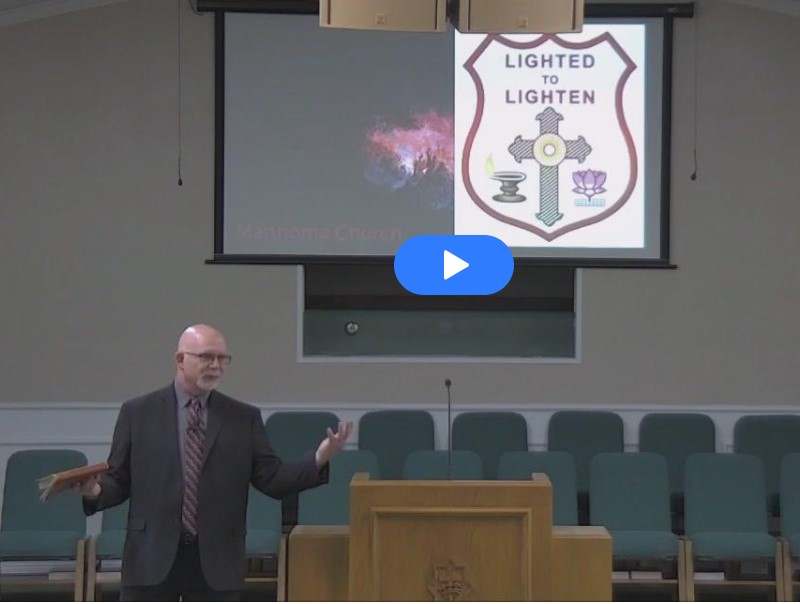
The Mar Thoma are Indian Christians who say their church originated with the Apostle Thomas. I have always liked their motto on their logo. It emphasizes the purpose for our calling to bless others because we have been blessed. The Gospel is not just about personal salvation. It has social and cosmic dynamics. The reason we are “lighted” is so that we can “lighten” others. This should be the purpose statement of all Christians. We need to be a full moon to a dark world until that world turns to the full day of the Son of God.

Subscribe to receive email notifications of new posts

Be a Full Moon to a Dark World (Matt 5:14-16)

Start sermon video
Bible, sermon

Godly Worship, Godly Fasting

Why do humans who say they love God repeatedly misunderstand what it means to worship God and to live a life that honors him? Before the exile, Amos warned about misdirected worship. After the exile, Zechariah noted the same problems remained. Even today, we still find so many who bear the name of Christ acting in the same way. Since these two sermons have a similar theme, I am sharing them together.

Amos (5:18-24) warned about the disruptive nature of the coming Day of the Lord. Today, we are living through one of those disruptive times with the COVID pandemic and racial protests. If we worshiped God the way he wants us too, we would be the salt and light that Jesus called us to be within the midst of this disruptive time. But unfortunately, we often do not understand what true worship means. God, through Amos, told the Israelites their worship didn’t pass three important “tests”: the smell test (God wouldn’t smell their sacrifices), the vision test (God couldn’t see their offerings), and the hearing test (God hated their music). Instead, as Martin Luther King Jr. so often emphasized, the worship God desires is for justice to roll on incessantly like the never-ending lapping of waves on the seashore and for righteousness to flow out from us like an unending river.

A little over 200 years later, as the second temple neared completion, some Israelites came to Zechariah inquiring whether they should continue the fast of remembrance for the destruction of Solomon’s temple. God, through Zechariah (7:4-10), asked if the fast was ever about him at all, or if it was about the loss of their own privileged position within the culture, the destruction of their political capital and collective power, and the embarrassment they felt at “pagans” getting the better of “God’s people.” Zechariah emphasized that true Godly fasting isn’t about simply denying personal desires or denying yourself to honor God. Fasting should be a denial of yourself for the sake of giving yourself for the other, whether that other is your neighbor or your enemy. Zechariah called the people to a fast from deeds of injustice, from acts of selfishness, from structures of oppression, and from plots of evil.

So both Amos and Zechariah emphasized true worship of God is found in active care and compassion for our fellow human beings. To love God we must love humans. The Good News of Jesus as the Christ is not an individualistic call to personal salvation, some type of a “get into heaven free” card for the end of life unrelated to daily living. Christian witness is not about proving the “rightness” of your beliefs through demeaning, confrontational or plain hateful social media posts. Advancing the Kingdom of God doesn’t depend on power politics that aggressively advance your agenda and demonize your opponents. If Jesus is the Christ, he is seated at the right hand of God ruling over all of creation. His followers are called to live and die as he did. Kingdom citizenship requires daily denial of ourselves in order that we might live for others. We are called to struggle against the injustices we encounter–not real or perceived offenses against ourselves or our personal rights (see Paul’s life!)–but injustice against others. We are called to defend the widow, the orphan, the foreigner, the poor–in a word, to seek justice for our neighbor, especially our marginalized neighbor. We don’t worship in anticipation of the future. We worship through living in the present, so God’s will might be done on earth as it already is in heaven.

Subscribe to receive email notifications of new posts

The Worship God Despises; the Worship God Desires (Amos 5:18-24)

The Worship God Despises; the Worship God Desires (link to sermon)

A Call to Godly Fasting (Zech 7:8-10)

A Call to Godly Fasting (link to sermon)
Bible, Jesus, sermon

The Way of Adam/ The Way of Christ

1 Cor 8:1-13. Meat offered to idols doesn’t seem to be a topic relevant to modern Westerners. Yet the body of Christ in a post-COVID world faces the same issues confronted by the first century Corinthian church. Their “strong” said they could eat meat, even in temples, because they knew there is only one God and the idols are nothing. They didn’t want their rights impeded by the “weak,” who believed in gods or demons behind the idols and so wouldn’t eat the meat.

While Paul philosophically agreed with the strong, he rejected their way of Adam, trusting in “knowledge” motivated by self-interest; a way that leads to death and destruction. Paul called the Corinthians to follow the way of Christ, putting the needs of others ahead of your own for the sake of love; a way that leads to community and life. While we can question governmental policies aimed at flattening the curve of COVID, we should never let our “rights” destroy the fellowship of the church or our witness of Christ’s love and rule. Paul would say, if going out in public without a mask causes death to the vulnerable and destruction to Christian unity and witness, I will never go without a mask again.

Subscribe to receive email notifications of new posts

The Way of Adam/The Way of Christ

Article referenced in sermon: Church Don’t Let Coronavirus Divide You

Bible, sermon

Rebuilding the Temple

Ezra 3:10-13.  As certain social distancing restrictions begin to lift, how to we faithfully relaunch physical worship services and ministry? By comparing the returning exiles’ rebuilding of the temple with our relaunching the church, we can see that we should seek God’s help to understand the times and know what to do; that we may occasionally make mistakes; that we may need to take incremental steps; and that our future may not be exactly the same as our past. Through it all, however, the glory of the future will outshine the glory of the past.

An example of semantron mentioned in the sermon:

Bible, Jesus, sermon

The Touch of Life

Mark 1:40-42.  Masks, gloves, social distancing. These are necessary precautions today with COVID-19, but at the same time, Christians cannot let these precautions interfere with our calling to be the body of Christ ministering in the world. We are to be the touch of life to our world the way Jesus himself was. The sermon looks at the story of a leper and some other stories about “touch” in the gospels.  Jesus was ready to touch the lives of others, even if it meant he might be misunderstood or become unclean, so that he could be a blessing and change lives.  We cannot ostracize groups or stigmatize individuals because of fear of COVID-19.  No.  We are called to be the hands of Jesus, touching others and giving life.

Bible, sermon

Darkness or Light in the Day of the Lord

Isaiah 2:12-22 — COVID-19 affects us all. We are all on edge and our lives disrupted. The Old Testament would call this the Day of the Lord.  A day when all of us are brought low. A day when all of us should be brought to repentance and prayer. When the Day of the Lord comes, however, it does nothing more dangerous than to reveal our heart through our actions and the choices we make. Ultimately, we can either respond to the day of the Lord as yet another excuse to blame others or we can see it as an opportunity to serve others. We must chose whether to be darkness or light.

Bible, sermon

Heal Our Land

In 2 Chronicles 7:12-22, God tells Solomon that he has placed his name in the temple Solomon built and will hear prayers from there.  He promises to heal the land in times of plague, famine, or pestilence if the people will humble themselves, pray, and turn from their wicked ways to seek God.  He also warns that he will destroy the temple to rubble if they do not.

The sermon talks about our call to prayer, the model of prayer in our Lord Jesus, and some ways in which we can participate in prayer for nation and our world, including praying through the Psalms.