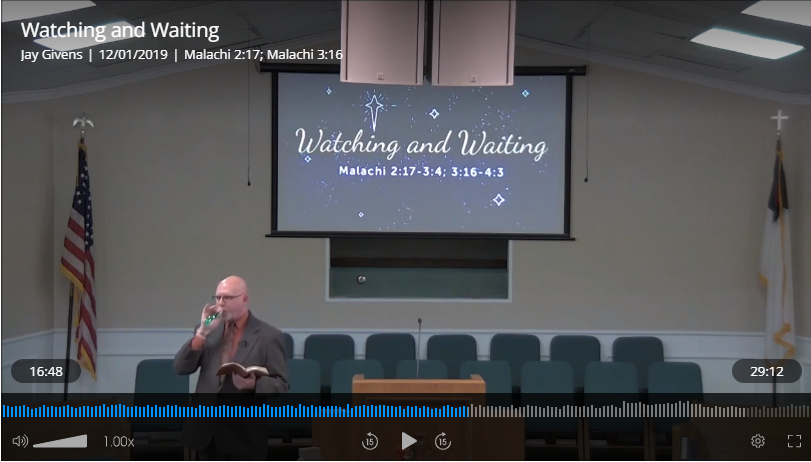
Advent is from the Latin word that means “coming.” It is a time when Christians through their imagination enter into the time of watching and waiting for the coming of the Messiah, as the ancient Jews also did. Advent is also a time when we recall to mind the watching and waiting we do for the return of Jesus. We anticipate the time when he will return to bring to fulfillment the Lord’s Prayer, bringing God’s kingdom in all its fullness, when God’s will shall be done on earth just as it is in heaven. Come, Lord Jesus!
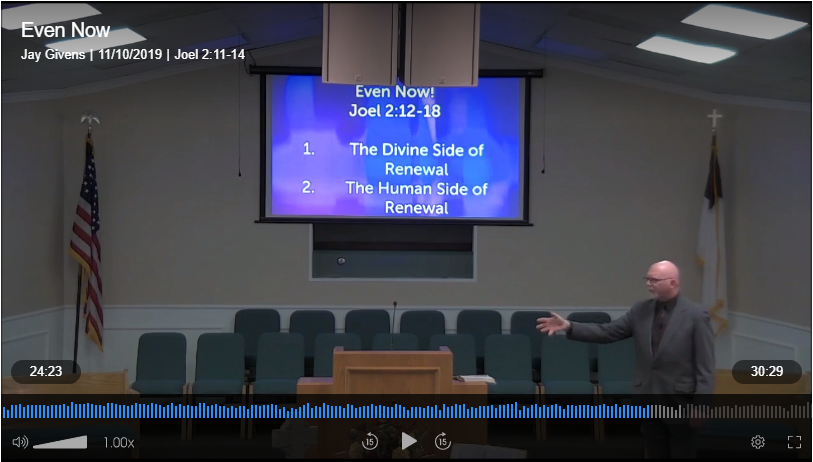
Regardless of how destroyed or fallen our world seems to be, Joel says, “Even now!” if we rend our hearts and turn to God with weeping and fasting, God might bless us. Yet even if no change occurs in our physical situation, we can be confident in the hope that our fellowship with him has been restored on account of his abiding grace and love.
While we remember God’s blessings with a special day of thanks, shouldn’t we reflect on what makes God thankful and strive to live that way everyday? God’s desire for us to live as an authentic witness as a transformed person within a unified body.
What is Thanks-living? Letting the peace of Christ (the New Man) rule our hearts as we confess our flaws to each other. Putting to death what remains of the Old Man (Adam) as we bear with and forgive the Old Man we see in other believers. Thanking God for the unity of believers as we embrace the diversity of our fellowship.
SermonAudio.com — archive First Baptist Church, Coahoma, TX, November 24, 2019
We tell ourselves stories all the time. Not verbally, necessarily; they can be the thoughts we think to ourselves—the narrative in which we view reality. The stories that we tell ourselves shape our understanding of the past, the way we live life today, and the person we will become in the future.
So where do we get our stories? Who do we listen to? What do we read? What do we set before our eyes? The ones we spend the most time with will inevitably have the most impact on the stories we tell ourselves and how we view our life as a narrative. I have been thinking about this quite a bit lately. It seems every book I pick up or podcast I turn on has this theme underlying it. What stories do we choose to listen to? The stories we tell ourselves will vary quite a bit depending on the input we select. And this variance can impact how we view our world, how live out our lives, how we see others, and ultimately, how we conceive of God.
You can see the impact of stories we tell ourselves within the pages of the Bible itself. As but one example, let’s look at the stories found in the Old Testament that attempt to explain the fall of Jerusalem to the Babylonian empire. The writer of 2 Kings argues that the fall of the kingdom of Judah was ultimately the consequence of the Israelites turning away from God and worshiping idols, especially during the time of King Manasseh (2Ki 21). The writer of 2 Kings then portrays King Josiah in heroic terms as someone fighting to undo the errors of his grandfather Manasseh, attempting to turn the nation back to God by destroying the temples, the idols, the high places, and even the priests and prophets that were leading the people astray (2Ki 23).
Heroic though Josiah’s efforts were, within 25 years of his death Jerusalem was destroyed by the Babylonians. Though the prophet Jeremiah supported Josiah’s reform movement (2Chr 35:25; Jer 11:21; 36:2), we find a far different story in the book of Jeremiah to explain the fall of Jerusalem. The story is told by some Jews who fled to Egypt with a kidnapped Jeremiah. They rebelliously tell Jeremiah that when they worshiped the Queen of Heaven (one of the various idols they worshiped), they “had plenty of food and were well off and suffered no harm. But ever since we stopped burning incense to the Queen of Heaven and pouring out drink offerings to her, we have had nothing and have been perishing by sword and famine” (Jer 44:17b-18, NIV). So where the writer of 2 Kings blamed the fall of Jerusalem on the people’s continuous worship of various idols and practice of things forbidden by God (cf. Jer 44:2-6), the Jews in Egypt instead blamed Josiah’s and Jeremiah’s reform for the destruction, since Josiah put an end to the worship of idols and Jeremiah continued to preach this policy through the destruction of the kingdom.
Just as the Jews interpreted a historical event (the fall of Jerusalem) within one of two narratives (either the result of the Lord God’s anger about idol worship or the Queen of Heaven’s anger that her worship had ceased), so we create a narrative to make sense of events that happen in our own lives. We tell ourselves stories. The question is, are we telling ourselves the right stories?
Advent means “coming,” as in the coming of Jesus. It is a time of waiting and anticipation. Do you realize how hard it is to slow down and wait in our culture? We’re a Netflix generation. On Friday, Boom! A whole season of some show drops. Don’t lie to me—you binge watch the season in a weekend, don’t you? You probably get impatient waiting 1 minute 30 seconds for a bag of popcorn that used to take 10 or more minutes to make. We don’t really know how to wait, much less be alone. Waiting for a friend? Hop on Instagram or Snapchat someone else. I’m not picking on you because you’re young. It’s everyone in our culture. I mean, my parents live in Southeast Texas. They know it takes me around 10-11 hours to drive one way to visit them. Yet my mother calls at least 3 times to find out where we are! . . . And she always sounds disappointed when she hears our progress! (Only in Abilene? I hoped you were closer to home by now!) What did people do before cell phones when loved ones traveled? Wait! Anticipate! Hope! Pray!
Those words also describe Advent. It is the time before Christmas where the Church has traditionally paused to remember the coming of Jesus. It is a time of reflection; a time to imagine ourselves waiting with the Jews for the birth of the long awaited Messiah. It is also a time to think about our own waiting, to anticipate and hope and pray for the return of Jesus, when he will bring the Kingdom of God in all its fullness.
For the Jews under Roman occupation, however, it wasn’t just waiting with hope. It was longing for the current situation to end and a new, radically different and wonderful situation to start. It’s like you feel right now. You aren’t just looking forward to the holidays. You are longing for classes to be over, for the weight of finals to be lifted—the days of term papers and projects and hardship and slavery to end! I still remember the last final exam for my bachelor’s degree. It was a music history course. I distinctly remember walking out of the room and down the long hallway. I sort of imagined a band would be out in the hall playing a triumphant march with maybe some confetti floating down from the ceiling! The day of liberation was at hand!
That same anticipation you feel for getting past finals to the wondrous freedom of the holidays is similar to the hope and anticipation the Jews felt right before the coming of Jesus. Their ancient prophets had promised a Messiah would come and bring in the Kingdom of God, yet they had been ruled over by Gentiles for the past six hundred years. The only momentary break came about two centuries earlier, when Judas Maccabeus and his family led a revolt that resulted in a century of freedom. But then the Romans arrived, ushering in a time of occupation yet again. Surely, they asked with the prophet Habakkuk, “How long, Lord, must I call for help, but you do not listen? Or cry out to you, ‘Violence!’ but you do not save?” (1:2) Not only were Roman soldiers an ever-present reality, but landowners grew rich at the expense of the poor workers; local rulers grew rich off taxes; and religious leaders sneered at the commoners who didn’t have the time to keep every law and precept because they were too busy trying to eke out a living. Many hoped and prayed for a coming Messiah, a great king who would rise up to overthrow these wicked oppressors and establish the Kingdom of God with the Jewish nation at its very center.
This coming king—the Messiah—was expected to do two great things: defeat Israel’s enemies and restore true worship to the temple. The great kings set these two agendas in Israel’s past. David was the great warrior king who secured the nation from its enemies. Solomon was the great temple builder. The two rulers called “greatest” in the Old Testament book of Kings—Hezekiah and Josiah—also defeated Israel’s enemies and restored temple worship.
But something strange and different happened. The Messiah’s coming wasn’t what the Jews had expected. Jesus didn’t talk about defeating the Romans. He told Gentiles they had “great faith” and Jews to pay taxes to Caesar. He didn’t talk about restoring worship in the temple. Instead, he acted out a curse on the temple and talked about its coming destruction. This is part of the reason many Jews of his day didn’t accept him as Messiah and why Jews today don’t follow him. “He came to his own, but his own rejected him.” (John 1:11) It was sort of like the anticipation I told you I felt when I turned in my last final. The band wasn’t there. No confetti cannons. Not even a single party horn. Just a long empty hall that I walked down . . . alone.
That strange and wonderfully different coming was sort of like my empty hall. The Word who was with God and was God and through whom all things were made became flesh and dwelt among us. Yet he lived a life of sorrows. The legitimacy of his birth was questioned, since Mary was a virgin when she conceived. Joseph, his earthly father, likely died while he was a teen, so he lived in a single parent home. His family thought he was out of his mind to challenge the local officials as he did. His disciples followed him but didn’t really understand his teachings. The religious and political leaders persecuted him.
Eventually, he was arrested, abandoned, beaten, and put to death on a cross. If Jesus wasn’t the Messiah the Jews wanted—one who would overthrow the Romans and oppressors and restore true temple worship—then he was worthless to them! Yet his Father approved of the life he lived and so raised Jesus from the dead. The First Letter to the Corinthians pictures him as a king reigning over us from heaven until he has defeated our greatest enemies: sin, death, and the grave. The book of Hebrews tells us Jesus, through his ascension, has entered the true temple, the most holy place—heaven itself—to serve for all time as our high priest. So Christ followers see that he did what Messiah was supposed to do—defeat our enemies and restore temple worship—but he did it in a way no one foresaw.
This Jesus, who ascended to heaven as both priest and king, will return again one day. Advent is a time of waiting and watching. Part of the advent hope is that Jesus will return and make the Lord’s Prayer a reality: That God’s Kingdom shall one day come, that God’s will shall be done on earth just as it currently is done in heaven. When he comes, Jesus will raise all humans back to life and will serve as our judge. This is what Christians wait for, long for, hope for during Advent—the coming of our priest, our king, our judge—as this video show.
Again, here is something unexpected. There is one coming to judge our lives, yet this Judge is one who understands. Our Lord isn’t a deity who sits way up on high, detached and distant from our pain and suffering. Instead, Isaiah says, he is a man familiar with suffering. The writer to the Hebrews tells us that
During the days of Jesus’ life on earth, he offered up prayers and petitions with fervent cries and tears to the one who could save him from death, and he was heard because of his reverent submission. Son though he was, he learned obedience from what he suffered and, once made perfect, he became the source of eternal salvation for all who obey him and was designated by God to be high priest in the order of Melchizedek. . . . This Melchizedek was king of Salem and priest of God Most High. (5:7-10; 7:1)
Our judge knows what it is to wait, for he learned obedience through it. He knows our fears and understands our suffering and struggles. Our king has defeated our greatest enemies—sin, death, and the grave—and offers eternal life through his own blood given as a holy sacrifice. Not only has he entered heaven itself to serve as our Priest, but here on earth he has built a temple not made by human hands but crafted by the Spirit of God. Each believer—whether Jew or Gentile, slave or free, male or female—is a stone in this one temple that Jesus is building and on which he himself is the cornerstone.
If you do not know Jesus as your Lord and Savior, my prayer for you this Advent is that you will come to know this man who is God. You can come up after chapel and speak to me or grab a friend and ask them how to become a Christ follower. While Advent is a time of waiting, don’t wait any longer to know the gift of God we celebrate this season.
Bow your heads as I read the words of Isaiah for our closing prayer:
Oh, that you would rend the heavens and come down, that the mountains would tremble before you! As when fire sets twigs ablaze and causes water to boil, come down to make your name known to your enemies and cause the nations to quake before you!
For when you did awesome things that we did not expect, you came down, and the mountains trembled before you. Since ancient times no one has heard, no ear has perceived, no eye has seen any God besides you, who acts on behalf of those who wait for him. (64:1-4)
Thank you, Father, that in Jesus you have acted in ways that we did not expect. With anticipation and joy we wait for you to bring forth your Kingdom in all of its fullness. In the name of your Messiah, Jesus, we pray. Amen!
Thomas Guthrie described the difference between the Bible and theology using floral imagery. He compared the formal organization of catechisms and confessions to the organized rows of flowers you would find in a botanical garden and the Bible to a walk through the woods where one can spot the various plants here or there in a haphazard fashion.[1] (Linked full on bottom of page.) Alister McGrath elaborated on the comparison, arguing the arrangement of flowers by species in the botanical garden helps one study each species more easily. The garden (theology) is not an end in itself, however, but a tool to help one better clarify similarities and differences between species and more easily recognize and enjoy flowers encountered in the wild (the Bible).[2]
After two weeks of readings. lectures, and discussions in the World Religions and World Religions Discourse summer institute funded by the National Endowment for the Humanities, I would propose a new way forward in the study of world religions using a modified application of Guthrie’s analogy. A problem with most textbooks is that they present the religious traditions primarily in a botanical garden format. This helps the student study “the Hindu” or “the Buddhist,” but it creates the impression that the rows of separated, differentiated species (“Hinduism” or “Buddhism”) are the “real world” (Hindus or Buddhists) and not simply a tool for better encountering the real world. In the real world, life is messy and disjointed. It isn’t a garden but a forest, sometimes overgrown and wild. Often the chapters attempt to show the “wild side” of the religions, but students get lost in the weeds of too many historical facts or confused how a described but detached practice or movement actually connects to the lived tradition.
But what if we gathered up these lost students out of the forest, took them to a botanical garden for a fairly quick tour to gain some working reference points, then took them back to the forest for a guided tour of the same flowers in their natural habitat? Would that give them a better understanding of the forest (the actual lived religions)? What if, after the forest exploration we then introduced the students to a second type of artificial encounter with the flora, not the striated rows of different species in the botanical garden but variegated groupings carefully selected and arranged? Would these bouquets (topical discussions) give the students yet a greater appreciation of the beauty and diversity of the flora encountered in the forest when left on their own?
A course following this threefold concept (with intro and conclusion) would do the following:
Lost in the Woods: Introduction to the study of religions.
Touring the Garden: The first part of the study would introduce students to some basic worldview concepts and practices of each religion, so that they have a basic concept of what a Hindu “is” in relation to a Buddhist.
Exploring the Forest: The middle part of the study would provide a historical discussion from the ancient past to the present, giving students a taste of how religions develop and change over time. What is the impact of cultural changes, historical events, political policies, or interaction with other religious traditions?
Picking Bouquets: The final section of the study would then help students consider some similarities and differences among the religions by talking about selected topics, such as missionary encounters, government responses, violence, or mysticism. The method would delve into selected events, writings, or lives across traditions.
At Home in the Wild: Closing reflections from a Christian perspective.
I would love to hear feedback on such a rearrangement of the subject. While no format is perfect, I think such an arrangement would help students gain a greater appreciation for the variety of faiths and practices. Is there something I am missing, need to remove, or rearrange? Or am I missing the forest for all of the trees?
[1]Thomas Guthrie, Gems of Illustration from the Sermons and Other Writings of Thomas Guthrie (New York: Funk & Wagnall, 1882), 42, accessed July 25, 2017, https://books.google.com/books?id=EYxBAQAAMAAJ.
Any views, findings, conclusions, or recommendations expressed in this blog do not necessarily reflect those of the National Endowment for the Humanities.
Going to a National Endowment of the Humanities Summer Institute in July at Macalester College in St. Paul. The topic will be Challenges of Teaching World Religions.
I love movies, the larger than life stories it can create (e.g., the Star Wars mythos), the liberties it can take at times with alternative realities (e.g., superhero movies) or creating new twists for old stories (e.g., flipping the climatic scene from Wrath of Khan in the Star Trek reboot Into Darkness). There certainly are new twists in the new movie, Young Messiah, and it certainly attempts to be larger than life in the telling of the story that is Life itself. I went to see the movie primarily because I thought I might have some students watch it and ask questions about it. (Or worse, just accept the story within the movie without question.) As a warning, the remainder of this blog will contain spoilers.
My biggest concern isn’t with the movie itself. Yes, the pacing of the movie is poor and the acting isn’t much better. I’ve never enjoyed an other-earthly Jesus. As much as there are some images of him laughing and playing, overall he seems detached. (Ignatiy Vishnevetsky’s review effectively and humorously deals with the pacing/acting issues.) If you are looking for a better paced/better acted movie, see the almost concurrently released Risen. On the other hand, the visuals of the Young Messiah were very good. The costumes were well designed and the scenery was much more authentic than the constant desert landscape offered in Risen. (Who could farm in the Galilee if it truly was as desolate as one sees in that movie? Its filmmakers seem to envision the Judean wilderness as definitive for all Israel!)
Now, please note that any attempt to imagine the silent years of Jesus will require imagination and creativity. I think that is fine and enjoyed the premise of viewing the gospel from a different perspective, but it needs to be done within a biblical and historical framework. I don’t even have a problem per se with how it seems modified versions of stories from the apocryphal Infancy Gospel of Thomas (IGT) are used in the movie. After all, I see no reason for Anne Rice to create a new story whole cloth when she could weave a new story around elements of preexisting legends.
In fact, I entered the theater expecting so much worse than what I found. Knowing the stories from the Infancy Gospel of Thomas, I feared Jesus would be portrayed as the impish wildchild found therein–a boy unchecked in his emotions with powers far beyond his control. For example, the movie picks up the idea of Jesus being bullied, raising dead children back to life, and making dead birds live. In IGT, Jesus curses a bully who shouldered him roughly in the street and the bully falls dead. The parents react in fear and tell Joseph to move away or at least teach his son not to kill children. Joseph reprimands Jesus, who then causes his accusers to go blind! (This is hardly turning the other “shoulder” or going the extra mile, is it?) Joseph then tries to find a teacher for Jesus, but Jesus confounds these teachers with obscure statements about the nature of letters before cursing one, striking another dead, and laughing at a third (though he seems pleased with this one’s realization he has been bested by Jesus). At some point in the stories, Jesus will undo the curses he has brought upon the people, but he seems to be power-mad in these stories, using miracles to invoke fear and/or worship. (There also seems to be some anti-Semitic undertone running through parts of them.) Jesus does raise some to life in IGT: a boy who cut his foot with an axe and bled to death, a playmate who fell from a roof (though Jesus mainly raises this boy as a character witness that Jesus hadn’t pushed the boy off to start with!), an infant in his mother’s arms, and an old man who then worshiped Jesus.
In the movie, by contrast, Jesus is much closer to the adult Jesus we find in the four gospels. It is the Demon shadowing Jesus who causes Jesus’ bully to trip on an apple, crack his head on a stone, and die. Yes, the crowds react in fear and demand Jesus’ family leave, but Jesus doesn’t strike them blind. Instead, he sneaks past them, into the dead boy’s room, and raises the bully back to life. So the movie blends these resurrection stories with the bully story, presenting Jesus as a concerned and compassionate little boy, not a wildchild acting in anger and demanding worship. Similarly, the dead bird on the beach seems to be a revisioning of the IGT story of Jesus playing in the mud making clay pigeons on the Sabbath. In that story, he brings the dead birds to life to “show off” in response to the criticism of a rabbi who asks Joseph why his son works on the Sabbath. In the movie, it is again the compassion of Jesus that drives his restoration of life to the dead bird.
My biggest concern about the movie is actually how many leading Christian voices have embraced the movie as “orthodox” or “biblical” despite important differences that exist between the movie’s view of first century Judaism and Jesus and what we know from history and from the four gospels. (Again, the imaginative approach is fine with me, if done within an historical context with biblical themes.) I think the portrayal of Jesus himself as a compassionate child growing and enjoying life nicely fit Luke’s statement about Jesus’ growth as a child. I also agree with the movie’s view that Jesus wasn’t aware of his unique status as Son of God. My problem is with the movie’s portrayal of all the people around Jesus knowing this “secret”–Mary and Joseph, Salome and Cleopas, as well as James and Miriam. I would even be ok with that if their view wasn’t that Jesus was a divine being, “more than human” as I recall Cleopas saying to Joseph at one point.
You see, the first century conception of the Messiah was not that he would be divine at all. The Jews expected God to raise up a human descendant of David to re-establish Israel and deliver the Jews from their enemies. The idea of Messiah as conquering king is properly mentioned in the movie, but their belief that Jesus was divine simply because of the virginal conception doesn’t fit with the gospel stories. In Mark, for instance, Mary and Jesus’ brothers thinks Jesus is out of his mind and goes to take charge of him . When Peter makes his great confession, “You are the Messiah, the Son of God,” we can see that Peter does not mean by this that Jesus was a divine being. For immediately after this confession, Jesus begin to teach his disciples for the first time that he will suffer and die. At this new teaching, however, Peter rebukes Jesus! If Peter believed Jesus was divine, he certainly would not think Jesus could err. Instead, Peter believed Jesus would be a great conquering human king. Jesus’ response is to rebuke Peter (get behind me, Satan!) for thinking of Messiah as humans conceived him (the conquering king) and not as God (the suffering servant). This idea that the King of the Jews was the Son of God goes back to the time of David. God promised David a dynasty, where his son would reign. “I will be his Father and he will be my son,” God says, but then he continues, “when he does wrong . . .” How could it be a divine son if he does wrong and must be disciplined by God? From what we can tell, every king of Israel was proclaimed Son of God at his coronation through the use of Psalm 2, especially verse 7. Even after the resurrection, the disciples still conceive of Jesus as the one to bring in a restored kingdom. It is only after the Spirit descends on them at Pentecost that they begin to understand that Jesus was more than a human being. He was indeed God made flesh.
In addition, the four gospels do not indicate Jesus had miraculous powers as a child. The movie has him doing miracles, yet wouldn’t this have called attention to him if he had? (The movie itself indicates that it did.) The only thing unusual about Jesus in the gospels is that he talked to the teachers in the temple at age twelve and impressed them with his questions and answers. Yet even this isn’t the “shocking” knowledge Jesus displays in the movie at age seven or eight, when Joseph goes to a rabbi and asks him to take Jesus on as a disciple. Instead, the Bible indicates Jesus grew as any other child and “discovered” his divine calling as Messiah at the baptism, around the age of thirty. Mark says the heavens were torn open (the same word used for the temple veil at Jesus’ death). In the movie, Mary tells Jesus he heals because he is divine. But Elijah and Elisha perform miracles such as Jesus and the Bible never says those men were divine. The response of people at the time of Jesus to his miracles was not, “Look! A divine being!” Instead, their response was that he was a prophet (like Elijah). As opposed to the movie, the gospels emphasize the role of faith the people had as being the key to healing, not anything intrinsic to Jesus himself. For example, Jesus wasn’t able to heal when people didn’t believe (in him?).
Closing on a related but somewhat random thought . . . did anyone else notice the Harry Potteresque ending to the movie? (Even though Chris Columbus was producer for both films, I don’t mean to imply this was intentional.) You have the climatic confrontation between the Boy (from Bethlehem) Who Lived and his “enemy” named Severus, a man who apparently serves a master fascinated/tormented with serpents yet in the end Severus is revealed to be an ally who protects the boy. Unlike the presentation in the movie, however, the people weren’t spreading rumors about the “Boy Who Lived” nor were authorities trying to hunt him down. Jesus, the young boy who would one day be revealed as Messiah, grew up in obscurity as any other human, for he was like we are yet without sin.

 Thomas Guthrie described the difference between the Bible and theology using floral imagery. He compared the formal organization of catechisms and confessions to the organized rows of flowers you would find in a botanical garden and the Bible to a walk through the woods where one can spot the various plants here or there in a haphazard fashion.
 After two weeks of readings. lectures, and discussions in the
  Would these bouquets (topical discussions) give the students yet a greater appreciation of the beauty and diversity of the flora encountered in the forest when left on their own?
