Bible, psalms, sermon

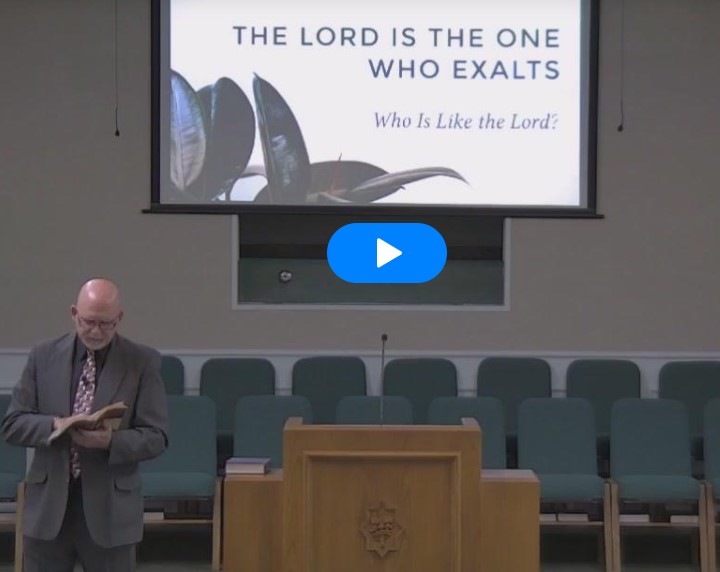
Who Is Like the Lord?

Psalm 113 is the first psalm in the Great Hallel of Passover (Pss 113-118). One thing that we find in the text is that we should exalt the LORD at all times. Because of the liberation of God’s people through the Passover, verse 1 describes the radical change that has occurred for the Hebrews. While in Egypt, they moaned and cried out because of oppression. Now, however, they shout “Hallelu Ya” (Praise the Lord)! Before the Passover, they were the servants of Pharaoh, but afterwards servants of the LORD. Three times in the text, there is an emphasis that the “name of the LORD” (YHWH) should be praised. To the Hebrews, the name was symbolic of someone’s character, so the praise the name was to shine a light on the character of the LORD. He is YHWH, the “I Am Who I Am” who fulfills his promises. At the burning bush, Moses is told that God is the I Am, the God of Abraham, Isaac, and Jacob, who will free the people and deliver them into the land promised to those ancestors. Because of who he is, we are to praise him now (whatever our current circumstances) and praise him forevermore. From the dawn to dusk, his name is to be praised (vv. 2-3).

Another thing we find in the text is that the LORD is the Exalted One. He is over all the nations. There is no God like him. His glory is described as being not “in” the heavens but “above” them. Who is like him? He sits on high as King of the Universe (vv. 4-5). Yet this great and mighty God who dwells above the heavens humbles himself. We are told that he stoops down to look upon the heavens and the earth. What is it he searches for as he lowers himself (rather non-regally) to stoop and search the earth?

The text tells us that he does this because the LORD is the One who exalts. The surprising thing in verses 7-9 is that the object of his gaze are the poor and the childless. We are told he raises the poor from the dust and the needy from the dung hill (NIV, “ash heap”). He even puts the poor onto level ground with royalty. The psalm reminds us of the parable of Jesus about the rich man and Lazarus. The poor beggar Lazarus is exalted at the end of the story while the rich man is punished. In the ministry of Jesus, we find his care focused on the blind, the lame, the lepers, the tax collectors, the so-called “sinners” (as defined by the religious elites). He shows compassion to them but engages in debate and argument with the rich and powerful (both politically and religiously). The placement of the poor and the prince on level ground can also be seen in the selection by the Spirit of Jesus of two of the primary early Christian leaders–Paul, the well-educated Pharisaic rabbi, and Peter, the plain-spoken fisherman. Jesus places them on equal footing (or even places Peter a little above as he was selected for leadership much earlier than Paul).

The other object of God’s focus, as mentioned above, is the childless woman. She will be “settled” in her home “as” a happy mother. The text doesn’t promise she will be a mother, but God will bless her just as he blesses the woman with child. Still, the statement reminds us of the care the LORD has for the motherless wife–Sarah, Rachel, Samson’s mother, and Hannah most notably. In fact, some scholars have noted the similarities between words and phrases of this psalm and Hannah’s song in 1 Samuel 2. Both images (the poor being exalted and seated and the childless being settled and happy) are apt images for the Exodus. The slaves are liberated from poverty; the mothers who lost children find happiness.

This compassion for the lowly and exaltation of the humble is the story of Jesus. Paul tells us that Jesus, though he was in very nature God, did not grasp at equality with God but humbled himself to become a servant. (The God who stoops in Psalm 113 is the same humble God seen in Jesus.) Jesus lowers himself into the dirt and dung of human existence, even to the point of a violent and humiliating death on a Roman cross. But then God the Father exalted him! He gave him “the name” (mentioned three times in Psalm 113) that is “above” every name (as God is “above” the heavens) so that all tongues will confess “Jesus is LORD” (Hallelu Ya!), for the name above all names is the name YHWH, the LORD.

This is also the story of the Church. Paul tells us that God chose the foolish and the lowly in order to shame the wise and the powerful. His purpose in so doing was to make sure that no one could boast about themselves (that is, be arrogant). They could only praise him in humility. Praise the LORD!

Subscribe to receive email notifications of new posts.

Who Is Like the Lord?” Psalm 113
Watch the sermon or download the audio.
psalms, sermon

Happy Are the Honest

Or — Miserable Are the Mule-Headed

What does it mean to be happy? Psalm 32 starts with two beatitudes (happy are . . .) and ends with an emphasis on rejoicing, being glad, and singing.

Instead of looking immediately at verses 1 and 2, however, let’s first look at the suffering of the sinner. Between the opening beatitudes and verse 5, which is connected to them, we find a description of the sinner in verses 3-4. “When I kept silent” (v. 3) reminds us of Adam in the Garden of Eden, silently hiding from God among the trees. Even when confronted, he wouldn’t confess his sin but blamed the woman and God himself. His refusal to speak aloud what separated him from God was what separated him from God. We must speak our sins, if for no other reason than we often don’t understand our actions until we attempt to put them into words.

When we keep silent, it might be because of our stubborn pride. It might be our fear of exposure and rejection. Or perhaps we trivialize the significance of our sin (for it is our “pet” sin). Ultimately, silence is a rejection of God’s grace by not seeking it. Maybe we think we are not worthy or don’t deserve his forgiveness. Perhaps we hypocritically try to hide the duplicitous nature of our life.

Whatever the reason, the psalmist says the sinner wastes away. Secret sin may bring us a fleeting pleasure, but it cannot bring us true happiness. The psalmist describes silence as destructive behavior–our bones waste away, our groans never end, we feel the heavy hand of God weighing down upon us, and our strength fades as in the excessive heat of the day.

But while the sinner suffers, there is forgiveness for the faithful. In verse 5 we find a dramatic shift. The psalmist says, “Then . . . ” No longer is the sinner silent. In fact, there is a triple construction emphasizing the confession of the repentant one.

True happiness is not found in secret sins but in a life laid bare. The two beatitudes at the start of the psalm also consist of a triple construction. Happy is the ones whose

  • Transgressions are forgiven
  • Sins are covered
  • Iniquity is not counted against them

As can be seen, verses 1-2 and 5 are connected by numerous words: transgression, sin, iniquity, covered, and forgiven. They are bookends around the silence of the sinner, surrounding it as evidence of the fuller life discovered by the one who repents. For when we confess, the Lord forgives, just as 1 John 1:9 tells us: “If we confess our sins, he is faithful and just and will forgive us our sins.” As James L. Mays says of this verse, “Confession of sin to God is confession of faith in God.” If we say we trust him, that we believe he is a God who is faithful and true to his covenant. Our confession should be, “I am a sinner, but you God, are gracious.”

Frollo confessing sins before flames
Photo from imdb.com

The confession that brings forgiveness (v. 5) also brings happiness (vv. 1-2). Confession isn’t just about what we’ve done; it is about who God is. The second beatitude ends by saying, the spirit of the happy one has no deceit. 1 John 1:8-10 states the opposite: if we claim we have no sin we deceive ourselves and make God out to be a liar. Or, perhaps most frightening, we can “confess” our sins as a way to prove our own “righteousness”–never really understanding our sin and so never truly confessing. Frollo, in the Disney movie The Hunchback of Notre Dame, “confesses” his lust for Esmerelda while he is actually extolling his own righteousness. (The animators invoke the irony by juxtaposing him against the flames of his hearth, which increasingly resemble the flames of Hell). As Paul warns us, God’s grace is not an excuse to sin, as if we are helping God out by giving him an opportunity to forgive us (Rom 6:1).

Finally, the psalmist describes the deliverance of the devoted. Verse 9 tells us to not to be like the horse or mule–who draws near to God not willingly but only because a bit and bridle force it to do so. Instead, we should accept God’s instruction, for he gives it in love. As Jesus said, “Come to me all you who are weary and burdened, and I will give you rest . . . . For my yoke is easy and my burden is light” (Matt 11:28, 30)

When trials come, verses 6-7 tell us to pray to God, for he is a high rock above the chaotic waters (like Noah), a cave protecting us from trouble (like David), and the one who surrounds us with songs of deliverance (like Jehoshaphat). Woes await the wicked, who face turmoil within and trouble without, but God’s love surrounds the devoted (that is, those who trust in the Lord).

Who are the righteous? Who are the upright in heart? They are not the sinless, for only Jesus the Christ is sinless. They are the honest, the authentic, those who confess their sin freely and so do not harbor deceit in their spirit. They are those who trust God by crying out to him, not hiding from him or pretending all is okay. Proverbs 28:13 succinctly summarizes Psalm 32: “Whoever conceals their sins does not prosper, but the one who confesses and renounces them finds mercy.”

Subscribe to receive email notifications of new posts

Psalm 32 sermon
Psalm 32: Happy Are the Honest (video or audio podcast)
psalms, sermon

In the Darkness of Despair

Gloom, despair, and agony on me.
Deep, Dark depression, excessive misery!
If it weren’t for bad luck, I’d have no luck at all!
Gloom, despair, and agony on me.

This farcical song of lament was popular on the television show Hee Haw while I was a kid in the 1970s. It reflects, however, the element of lament that is the most popular form of literature in the book of Psalms. There are times we cry out to God in desperation. Psalm 13 is one such passage.

The psalmist is dejected and confused in his time of despair. “How long?” he asks God four times. When will this end? As humans, we all have external struggles and troubles of life that begin to cause internal doubts as we wrestle with conflicting thoughts and eventually prompt spiritual concern about the presence of God and his lack of response to our prayers. The psalmist focuses on all three issues (external, internal, spiritual), but he inverts them and begins first and foremost with a prayerful address to God. His prayer is about his dread of God’s absence, his anxiety created by conflicting thoughts and emotions, and his fear of his enemy’s triumph. In our minds we can package these into nice little groupings of “external,” “internal,” and “spiritual,” but in reality, we are human. These fears and concerns are all intertwined and build upon and incite one another.

Second, the psalmist desperately cries out to God. It would be easy to claim God has abandoned us. If he is all loving, why does he allow my suffering? If he is just, why does he allow my enemy to overpower me? But we live in a broken and fallen world, not the fantasy of a thirty minute sitcom. Some struggles and problems are not quickly resolved. But the psalmist prays in the midst of his darkness. “How long?” he asks. “Look at me!” he demands. “Respond to me!” he pleads. He will not give up on God. He will not deny God but confesses his dependence of the Lord. Whether he overcomes his enemy or is destroyed, God has been and will remain, “my God!”

Finally, the psalmist is determined to be committed. There is a shift in the psalm to an emphasis on trusting God in the midst of the storm. He will trust in God’s steadfast love–the love evidenced time and again through the history of the Israelite people. He will rejoice in God’s salvation even when he doesn’t presently see it. He will sing of the bounty God has blessed him with even when it isn’t in all the fullness he would wish.

Because of God’s faithfulness in the past, the psalmist refuses to accept a present apart from God or imagine the future apart from God’s salvation. Martin Luther said of Psalm 13 that it is “the state in which hope despairs, and yet despair hopes at the same time; and all that lives is ‘the groaning that cannot be uttered’ wherewith the Holy Spirit makes intercession for us, brooding over the waters shrouded in darkness.” Or, as the man in desperation cried out to Jesus, “I do believe; help me overcome my unbelief!” (Mk 9:24, NIV). In the midst of desperation, we have hope because Christ. On the cross he felt abandoned by God yet he entrusted his spirit to his Father; he felt betrayed by the humans he had come to save but asked his Father to forgive them. And he trusted his Father would raise him back to life even when all hope seemed lost. So our hope in in Christ. “For we who are alive are always being given over to death for Jesus’ sake, so that his life may also be revealed in our mortal body” (2 Cor 4:11, NIV).

19th Century preacher Charles Spurgeon and a friend, walking through the English countryside, came across a barn and stood looking at the weather vane on top. It read “God is Love.” Spurgeon said he did not think it was appropriate to put such a statement on a weather vane, for the vane is quite changeable but God’s love is unchanging. His friend, however, told him he misunderstood the meaning of the farmer. The weather vane stated a truth: no matter which way the wind might blow, God . . . IS . . . love! It doesn’t matter if a cool breeze indicates a good season or happy time, or hot winds bring desolation or a dry period, or a ferocious gale points toward a chaotic and stormy period in your life. God is love, and Christ is our guide pointing the way through.

Subscribe to receive email notifications of new posts

Sermon link
Psalm 13 “In the Darkness of Despair”
psalms, sermon

Your Labor in the Lord Is Not in Vain

Always give yourselves fully to the work of the Lord, because you know that your labor in the Lord is not in vain. — 1 Corinthians 15:58, NIV

The U.S. holiday of Labor Day began in the late 1800s, at the height of the Industrial Revolution. At the time, the average American worked 12 hours/day, 7 days/week to make a basic living. Children as young as 5 or 6 often worked in mills, factories, and mines because employers could hire them for a fraction of the cost of an adult worker. Working conditions for both children and adults was often very unsafe. Long hours and children are, in fact, the focus of Psalm 127, to which we will turn in a minute.

In the late 19th century, labor unions became more vocal, organizing protest rallies and strikes. In today’s language, they would have been emphasizing “Workers Lives Matter.” Most protests were peaceful, like the 10,000 workers in New York who took unpaid leave on the first Monday of September 1882 to march from City Hall to Union Square, creating the first Labor Day parade in the United States. At times, protests erupted into violence by protesters and/or the police and troops assigned to maintain order. The Haymarket Incident in 1886 resulted in the death of several Chicago police and workers. The Pullman Strike of 1894, which lasted over two months, resulted in more than a dozen worker deaths at the hands of federal troops. Soon after, Congress, in order to repair ties with the American worker, passed a law recognizing Labor Day as a federal holiday.

As we consider Psalm 127, we see that, without the Lord, our labor is in vain. Three times in the first two verses, the psalmist reiterates the phrase “in vain.” Whether building a house, standing guard over a city, or engaging in daily labor–all is in vain unless our work is within the Lord’s greater work. Even if we rise early and do not eat the bread earned from our “painful toil” until late in the evening (v. 2), our work is in vain if we view it as the goal or the end itself, our purpose for living. Perhaps that is why the psalmist shifts gears in the rest of the psalm to speak of children (vv. 3-5). The psalmist says children also are “from the Lord.” (Note that he doesn’t say children are “in vain” apart from God, so family or relationships are, at the very least, a “better” end or goal.) Yet whether we speak of our physical labor or the labor of bearing children–our lives find their ultimate meaning when they are in the Lord.

A second thing we find in the psalm is that, with the Lord, Eden’s curse is undone. Again, verse 2 speaks of the bread of “painful toil.” The Hebrew (עֵצֶב) describing the bread has the same root word that we find in the curses spoken in Genesis 3:16-17. After humans ate the fruit of the tree of the knowledge of good and evil, God pronounced the land cursed so that the man had to work the ground with painful toil for the food he would eat. Childbirth was cursed so that the woman brought forth her children with painful toil. And so here, we find work (vv. 1-2) and children (vv. 3-5) as the twin themes of the psalm.

But in the psalm, we find that the Lord grants sleep to those who love him. This sleep is juxtapositioned with the sleeplessness of the person who works in vain apart from the Lord. It is also apposed to the guards who “stand watch” as the Hebrew term (שָׁקַד) carries the idea of “wakeful” or “sleepless.” For those who trust God, they are blessed with productive sleep in place of unproductive and unending toil. While they continue to engage in hard work, it is not their end. They do not worry about the outcome but find their rest in the Lord. We find the same idea in Proverbs 10:22, “The blessing of the Lord brings wealth, without painful toil for it” and Jesus’ promise, “Come to me, all you who are weary and burdened, and I will give you rest. My yoke is easy and my burden is light” (Matt 11:30).

In the psalm, the Lord gives children by the handful or quiverful (v. 4-5), specifically “sons.” To have many sons in the ancient world was important. They provided strength in potential times of conflict or negotiation (cf. v. 5). They brought respect in life and welfare in old age to the parents. They were also a way for your legacy to extend beyond your physical death. In verse 3, these children are called “fruit of the womb,” harkening back to the first commandment given to humans to “be fruitful and multiply” (Gen 1:28). Psalm 128, the companion to Psalm 127, picks up on this fruit imagery, calling one’s food the “fruit of your labor,” one’s wife “a fruitful vine,” one’s children “olive shoots,” and ending with a prayer that one sees “your children’s children” (that is, to see the olive shoots become fruit-bearing trees). So when humans chose their own way in Eden, God pronounced a curse describing what this life outside the Lord’s will would be like. Psalm 127, however, speaks of Eden’s curse being undone for those who seek to live “in the Lord.” (Perhaps this is why Paul emphasizes being “in Christ” so frequently.)

Finally, we are called to trust the Lord in all areas of our life. Reading through the psalm, we find that it is the Lord who builds, the Lord who watches, the Lord who gives sleep, and the Lord who grants children. That said, we must understand that the psalmist is speaking in corporate terms. He surely was aware that not all work is productive nor all marriages fertile. Yet even in these individual times of drought, we are called to trust the Lord with all areas of our lives.

The psalm’s superscription identifies it as a “song of ascents,” most likely a song to be sung by pilgrims as they traveled to and from Jerusalem for festivals. If this was its purpose, then the “house” becomes the temple, the “city” becomes Jerusalem, and the “sons” become either the sons of David (the kings) or the nation as a whole. This helps us see yet again that we are called to trust the Lord in all areas of our life–our religious life (the house), our political life (the city), our vocational life (toil for bread), and our family life (children). Trusting God in all areas of our life is described in Psalm 128 as the “fear of the Lord.” Paul, writing to Timothy, called it hope. “That is why we labor and strive, because we have put our hope in the living God, who is the Savior of all people, and especially of those who believe” (1 Tim 4:10). This Labor Day, make sure your work is within the Lord’s work so that you can rest knowing that your labor is not in vain.

Subscribe to receive email notifications of new posts

Psalm 127 “Your Labor Is Not In Vain” (video or audio podcast)